Українська
  Русский
  Polski
  Deutsch
  Français
  Español
  Nederlands
  Svenska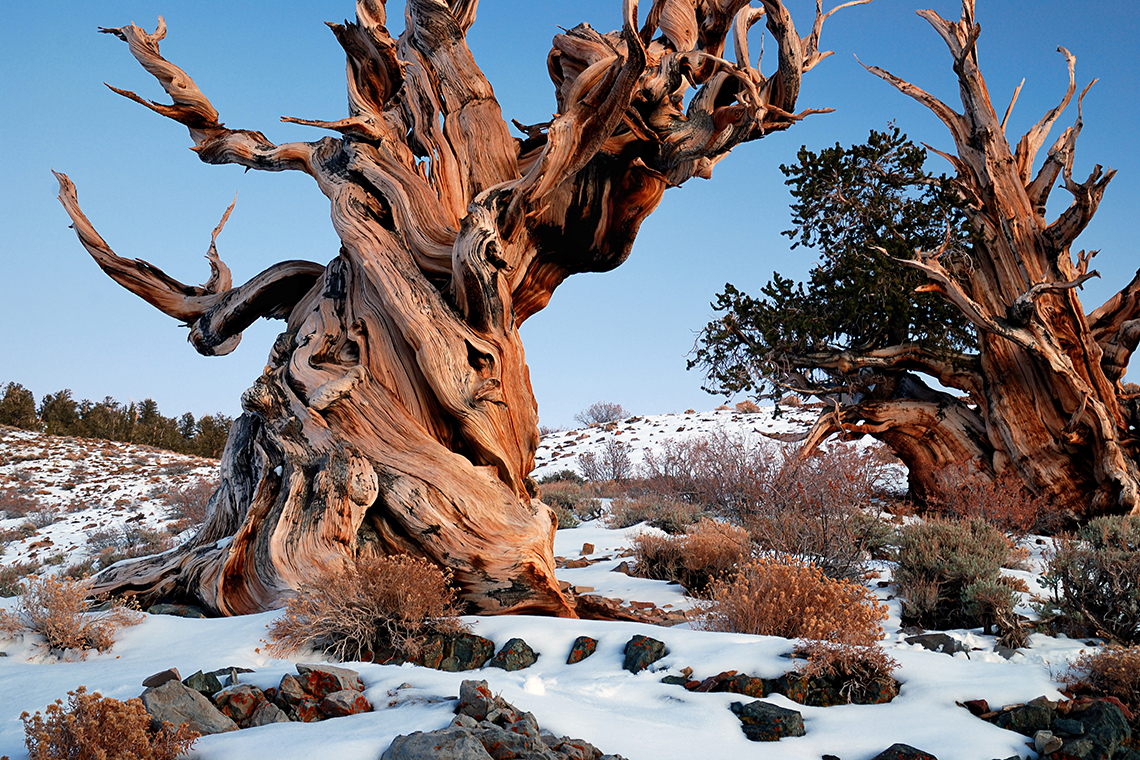
To enlarge, press the image | wikimedia.org
In California's high mountains, among rocks and harsh winds, grows one of the planet’s most astonishing forests—the Ancient Bristlecone Pine Forest. These trees aren't merely old; they're living witnesses of millennia, the oldest living organisms on Earth. To put it in perspective, some of these trees began their lives even before the Egyptian pyramids were built. Walking among trunks twisted by time, visitors feel as if they're traveling deep into history, alongside living witnesses of ancient epochs.
What Makes This Forest So Special?
Bristlecone pines grow at altitudes over 3,000 meters in the Wasatch and White Mountains. It is one of the harshest natural environments where a tree can survive. Here, the soil is rocky and poor, there's hardly any rainfall, and winters last up to eight months. Yet, these extreme conditions have made Bristlecone pines exceptionally long-lived.
Some of these trees live for more than 4,800 years. For comparison: when the oldest of these trees first sprouted, Egypt’s pyramids had not yet been built.
Why Do Trees Live So Long Here?
Several reasons exist, all related to survival in harsh conditions. These pines grow at elevations around 3,000–3,300 meters above sea level, where conditions are extremely severe: thin air, strong winds, scorching summer sun, and freezing winter snow. The soils here are rocky and nutrient-poor. However, this inhospitable environment actually contributes to the trees' longevity.
- Slow growth. In cold and drought, trees grow very slowly—sometimes just 1 mm per year. This makes their wood dense and resistant to decay.
- Harsh climate. Low temperatures and dry air prevent the proliferation of fungi, insect pests, and other factors that typically weaken trees in milder climates.
- Partial vitality. The oldest trees may have only one or two living branches left, yet the tree continues to live. It seems to “shut down” unnecessary parts to conserve energy.
This combination of factors creates an ideal recipe for longevity.

To enlarge, press the image | Image by Paul from Pixabay

To enlarge, press the image | rawpixel.com
The Oldest Tree on the Planet
In this forest grows a tree named Methuselah, considered one of the oldest living organisms on Earth. Its age is about 4856 years. Thus, Bristlecone pines significantly surpass any other tree species in terms of longevity. By comparison, the famous giant sequoias live up to 2–3 thousand years, while the oldest oaks are around a thousand years old.
The exact location of the Methuselah tree is not disclosed to protect it from damage and vandalism. However, visitors can hike along the Methuselah Trail and find themselves near this living piece of history—without knowing exactly which tree it is.
You can find more fascinating information about this tree in our article “Methuselah Pine: The Oldest Tree in the World”.
What Does the Forest Look Like?
Although the word “forest” conjures images of dense woodland, the Bristlecone forest is entirely different. It's more like sparse groves scattered across mountain slopes. The trees grow at significant distances from each other, sometimes in groups, but there is no dense canopy—the sun floods the slope unhindered all day long. The landscape feels otherworldly: pale-grey limestone rubble, a deep-blue sky above, and sparse, dark-green bushy crowns sticking out of the white ground. Some slopes are dotted with twisted silhouettes of dozens of trunks—they look like figures placed on hills by humans from afar. Only upon approaching closer does one realize these sculptures are living (albeit partly dead) trees.
In Patriarch Grove, at about 3,350 meters elevation, Bristlecone pines take on bizarre shapes. Their twisted trunks and wind-stripped bark create a landscape reminiscent of an alien world.
Every old tree has its own unique “character.” One trunk spirals around its axis; another is split by lightning and charred; a third is tilted parallel to the ground, holding onto the cliff with its last strength. The bark on living strips of the trunk often has a bright reddish-golden hue, while the dead wood is bleached by the sun to a silvery-grey color. This creates an astonishing contrast: from afar, the trunks seem to glow orange and white in the sunlight.
Many trees look half-dried, almost dead—and indeed, most of their mass has long since ceased to live. Needles grow only on one or two remaining branches, so the crown is very sparse, and the rest consists of bare limbs sticking out into the air like dry tentacles. Without knowing, it’s difficult to believe such a tree is still alive. Sometimes tourists ask guides: “Are these trees definitely not dead?”—to which the answer is that “the oldest trees no longer look lush, yet they continue to grow.”
Indeed, the oldest Bristlecone pines produce almost no new needles or shoots; they just slowly exist, very, very slowly. And yet each tree continues adding new annual rings—microscopic perhaps, but nonetheless a sign of life.
The atmosphere in the forest is unique—quiet and majestic. There’s almost no birdsong (the conditions are too harsh for most birds), just the wind whistling among the rocks and dry branches. The air is thin and requires adaptation: at altitudes over 3,000 meters, many people experience slight dizziness or shortness of breath. However, the sky here appears particularly clear and bright. During the day, sunlight is scorching, but the moment it slips behind a cloud, it instantly becomes chilly, reminding you of the nearness of cosmic cold. At sunset, white slopes turn delicate pink, and ancient pines cast long shadows. At such moments, the forest truly resembles an open-air museum—it feels like walking among exhibits preserving the planet's history.

To enlarge, press the image | flickr.com

To enlarge, press the image | flickr.com
Interesting Facts
- Bristlecone pine wood is incredibly resistant to decay. Even after death, a tree can remain preserved in dry climates for over 7,000 years. Scientists have found trunks fallen thousands of years ago still lying untouched.
- Each ring on a cross-section is a chapter of climate history. Dendrochronologists study the annual rings of these pines to reconstruct weather conditions over millennia. Some climate models for Europe and Asia rely on data from this forest.
- The forest survived ice ages, droughts, and dust storms. This makes it not only ancient but also a unique natural “archive of resilience” in a changing world.
- Branches can live independently of the trunk. In some trees, most of the trunk has long since died, but a single living branch continues to function, keeping the tree alive.
- Bristlecone pines grow so slowly that one ring can be as thin as a human hair. Sometimes it takes two years to form a single ring—especially under extremely harsh conditions.
- The shape of the trees resembles sculptures. Due to constant wind and heat, trunks twist, bend, and visually resemble abstract wooden statues.
- The Bristlecone forest is protected at the U.S. federal level. It is part of the Inyo National Forest and is considered a specially protected natural area.
Practical Information for Travelers
- The forest is located in California, in Inyo County, near the town of Bishop.
- The most famous part is the Schulman Grove, equipped with a visitor center and hiking trails.
- Altitude is around 3,300 meters, thus mountain acclimatization is possible. When planning a hike, consider gentle physical exertion and monitor your health.
- The best time to visit is from June to October, when roads are open and snow has melted.
- Recommended items to bring: warm clothes (even in summer), water, sunglasses, a hat, and a camera—the landscapes are unforgettable.
Why Visit This Forest?
A trip to the Bristlecone forest isn't just a walk in the mountains. It’s an opportunity to touch the thousand-year history of nature, to sense the scale of time rarely felt in daily life.
It’s a place where antiquity becomes visible. Where a tree is older than any currently living civilization. Where nature’s strength manifests not through growth, but in its resilience.