Українська
  Русский
  Polski
  Deutsch
  Français
  Español
  Nederlands
  Svenska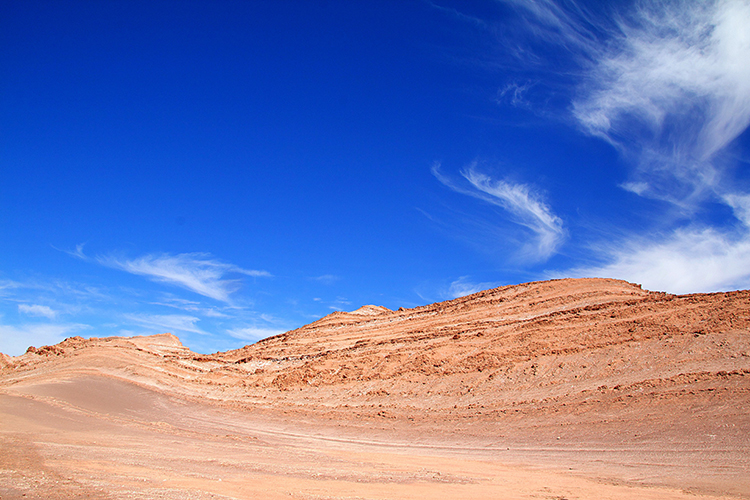
The driest place on Earth is not a hot sandy desert, as many people think. If you ask people at random, many will name the Sahara or the Atacama Desert in Chile. Indeed, these regions are extremely arid: rainfall is rare, and the landscape appears almost extraterrestrial.
However, the true record holder for aridity lies in a completely different place — on the cold southern continent of Antarctica. Let’s see why the greatest “dryness” is found there and what makes these extreme corners of the planet so remarkable.
What Is Considered a Desert, and Why Dry Doesn’t Always Mean Hot
To begin with, a desert doesn’t have to mean scorching sun and sand dunes. The key feature of a desert is low precipitation. By a widely used criterion, an area is considered desert if it receives less than ~250 mm of precipitation per year (that is, under a quarter of a meter — roughly up to 10 inches of rain or snow). It is aridity that defines a desert, not air temperature. There are also cold deserts — places that are very dry but not hot.
For example, Chile’s famed Atacama Desert — one of the driest places on Earth — lies on a plateau high above sea level next to a cold ocean current. Because of this, the climate there is unusually mild for a desert. In summer, daytime temperatures rarely exceed 19–20 °C, so it never experiences the searing heat typical of the Sahara or the Arabian Desert. Yet by precipitation, the Atacama breaks nearly all dryness records.
Sahara and Atacama: Dry Extremes
For comparison, take the Sahara Desert in North Africa — the world’s largest hot desert. In its central regions, rain is a very rare event: in some places no more than 20–30 mm of moisture falls per year (a couple of centimeters!). On average across the Sahara, annual precipitation is about 70–100 mm — just a few centimeters of rain a year. That is extremely little, which is why the Sahara looks so lifeless.
However, the Atacama Desert is even drier. Average precipitation in the Atacama’s central part is around 15 mm per year, several times less than even in the Sahara. And in the driest pockets of the Atacama, only a few millimeters of rain fall annually. Some weather stations there have never recorded rain over their entire history of observations!
Geologists believe that in the core of the Atacama there may have been no significant rainfall for more than 400 years in a row — from the 16th to the 20th centuries. Imagine: centuries without rain. No wonder the ground is crusted with salt and cracked clay, and living organisms are exceedingly scarce.
Such tiny precipitation totals make the Atacama the driest hot desert in the world and the second-driest place on the entire planet. In essence, its central areas are a benchmark waterless surface, reminiscent of Martian landscapes.
Scientists actively use this: Mars rovers and life-detection equipment are tested in the Atacama because conditions there are close to those on Mars. For example, dense coastal fogs (camanchaca) bring a little moisture from the ocean — enough for some lichens and bacteria to survive. But overall, vast stretches of the Atacama look so lifeless that they serve as a model for studying extraterrestrial deserts.

Barren landscape in the Atacama Desert | stock.adobe.com
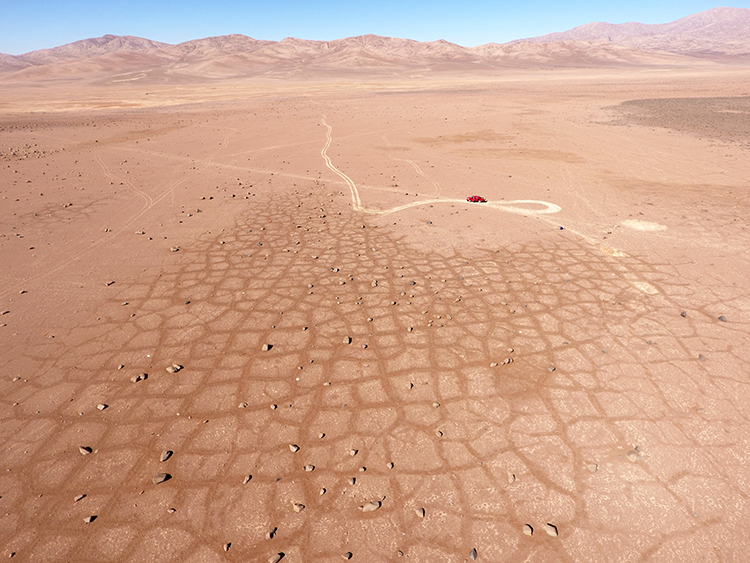
Patterned ground in the hyper-arid core of the Atacama Desert | wikimedia.org
Antarctica: The Driest Continent
Surprisingly, the absolute record for dryness belongs not to a hot desert but to the icy continent of Antarctica. Although we picture Antarctica covered in ice and snow, by climatic standards the entire continent is one vast desert. Precipitation (mostly snow) averages about 50 mm per year on the interior plateaus and up to 200 mm per year along the coasts. In liquid-water terms this is comparable to the most arid parts of the Sahara. It’s just that precipitation falls as snow, which accumulates over years. But there are places in Antarctica where not only is there no rain — there is never any precipitation at all from the sky.
These are the so-called McMurdo Dry Valleys — a unique region on the continent’s edge. Covering about 4,800 km², the valleys lie between high mountains not far from the coast. They are almost completely free of surface ice and snow — bare rock and soil, like on Mars. Scientists are confident that in some of these valleys it has not rained for about 2 million years! Yes — millions of years without a single drop. Even the occasional wind-blown snow either sublimates immediately or is swept away.
Why are the Antarctic Dry Valleys so arid? Several factors converge here. First, the valleys are ringed by mountains that create a “snow shadow” — a barrier to moist air masses from the ocean. Clouds simply cannot crest the ridges, so precipitation never reaches the valleys. Second, the frigid Antarctic air contains little moisture by itself (the colder the air, the less water vapor it can hold). But the main secret is the special katabatic winds.
Katabatic Winds: Natural Phenomena of Antarctica
Katabatic winds (from Greek katabatos — “descending”) are flows of very cold, heavy air that rush down from Antarctic glaciers under the force of gravity. Imagine: on the high icy plateau, air cools to extreme temperatures and becomes dense. This heavy air literally drains down the mountain slopes into low areas — the very same Dry Valleys. As it descends, it accelerates to incredible speeds — up to 300–320 km/h. Such hurricane-like gusts are among the fastest constant winds on the planet.
When a katabatic wind sweeps into a valley, it acts like a giant hair dryer: relatively warm (by Antarctic standards) and extremely dry air instantly evaporates any moisture in its path. Snow sublimates directly from the surface before it can accumulate. Even ice can gradually sublimate — turning straight from solid to vapor.
As a result, neither snow nor ice remains in these valleys — only bare rocks and dust everywhere. Because of this extreme dryness, the Dry Valleys are sometimes called Antarctic oases — ironically, of course: instead of water, there is complete desolation, but there is an “oasis” in the sense of ice-free land.
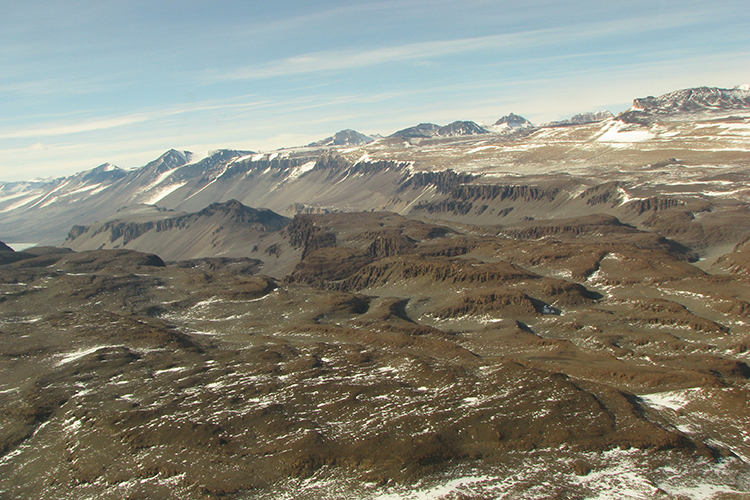
The Labyrinth, Wright Valley, McMurdo Dry Valleys, Antarctica. View eastward down Wright Valley from the beginning of the Labyrinth. | wikimedia.org
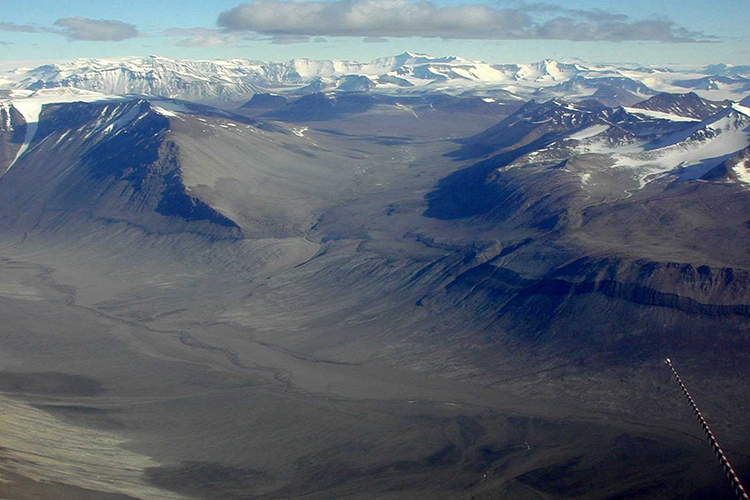
Bull Pass in the Dry Valleys of southern Victoria Land. The Dry Valleys here stretch for about 1,500 square miles and are almost completely free of snow and ice. | wikipedia.org
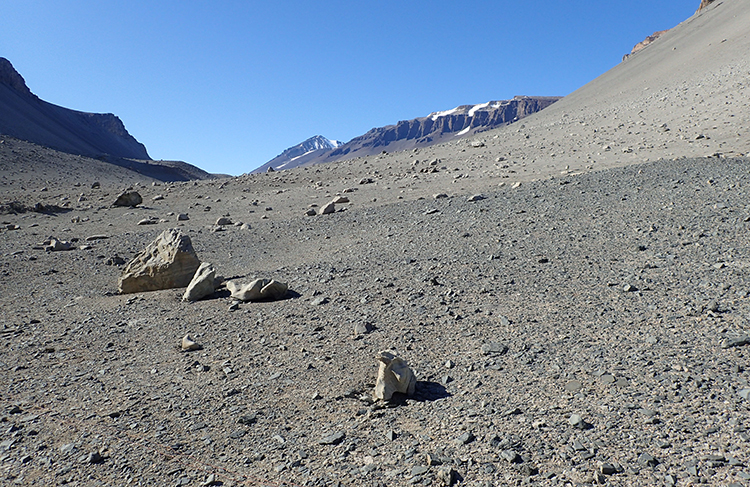
Landscape of the South Fork of Upper Wright Valley, part of the McMurdo Dry Valleys complex | wikimedia.org
Paradoxes of the Driest Place
Antarctica is unique in that it combines several natural world records at once. It is the driest place on Earth, yet also the “wettest” in another sense: nowhere else holds as much water as the Antarctic ice. About 70% of the planet’s fresh water is locked within the Antarctic ice sheet. Thus, the driest continent stores the lion’s share of Earth’s water — though frozen. If all this ice melted, the level of the world ocean would rise by almost 60 meters — that’s how much water the Antarctic deserts contain!
Another paradox lies in the Antarctic winds. As we’ve learned, the most powerful winds on the planet blow here. Average annual speeds in some areas break records — for example, near the Dumont d’Urville Station on the coast, gusts up to 327 km/h have been recorded. Constantly raging katabatic winds make Antarctica also the windiest place on Earth. Unlike hot deserts, where the air often stands still in scorching heat, the Antarctic desert is filled with an almost ceaseless howling wind that churns the dry air.
Finally, despite its extreme conditions, life still finds ways to exist even here. The driest valleys of Antarctica seem lifeless — no plants, no animals, no microbes in the soil. For a long time, they were thought to be nearly sterile. But scientists discovered their own hidden “secret oases”: inside certain rocks (within micro-cracks), colonies of photosynthetic bacteria live. These microorganisms use tiny traces of moisture condensing inside the stone and hide from the icy wind.
This mode of survival resembles possible forms of life on Mars. It’s no coincidence that NASA conducts tests of Mars mission equipment in the Dry Valleys and similar sites. Back in the 1970s, before sending the Viking probes to Mars, scientists tested their instruments in Antarctic valleys — since, by conditions, this is the closest place on Earth to Mars.
Conclusion: An Unexpected Champion of Dryness
So, the driest place on Earth is not a scorching sandy desert but cold, lifeless valleys in Antarctica. Despite the eternal ice surrounding them, these valleys haven’t seen rain for millions of years and receive almost no moisture. The story of the Dry Valleys reminds us how diverse Earth is: beneath Antarctica’s ice lie “oases” of dryness that surpass all deserts.
And although most people will never visit these harsh places, knowing about them broadens our understanding of life’s possibilities and the extreme limits of climate on our planet. This astonishing combination — a desert on ice, extreme dryness in a land of eternal cold — once again proves that nature is full of incredible surprises.