Українська
  Русский
  Polski
  Deutsch
  Français
  Español
  Nederlands
  Svenska
Mongooses are small but very agile mammals, known for their ability to fight snakes. Many first heard about them thanks to Rudyard Kipling’s story “Rikki-Tikki-Tavi,” where a mongoose plays the role of a brave protector. And it’s not fiction — in Southeast Asian countries, these animals are actually kept in homes to scare away snakes.
But what of this is true, and what is just a beautiful legend? Let’s find out.
Truth and Myths About Mongooses
There is a folk belief that when a mongoose is bitten by a venomous snake, it immediately finds a special healing herb, eats it — and miraculously recovers. In reality, things are simpler (and at the same time more amazing): mongooses are so fast and agile that they can avoid bites. In battles with snakes, they are protected by their thick fur, tough skin, and incredible reflexes. They aren’t immortal — they’re just good fighters.
Fun Fact
Mongooses can indeed defeat many snakes, but it doesn’t always depend solely on their skills. For example, in the 1960s in Yugoslavia, mongooses were introduced to eliminate snakes at resorts. However, the local snakes turned out to be faster and more dangerous than the ones the mongooses were used to in their native habitats. As a result, many mongooses died — the experiment failed.
Where Mongooses Live and How They Behave
Mongooses are remarkably adaptable creatures. They can live in a wide variety of places: forests, plains, gorges, and even hollow trees. Some species are active during the day, others at night. In the morning, mongooses enjoy basking in the sun, and on the ground, they move with astonishing agility. Some species can climb trees, but overall, they are ground-dwelling animals.
They can live alone, in pairs, or in large groups — up to 40 individuals.

What Mongooses Eat
The mongoose diet is quite varied. They eat insects, crabs, small mammals, fish, frogs, birds, and snakes. They can also consume fruit and plant matter. Despite a popular myth, mongooses do not have immunity to snake venom. They are just so fast that, while dodging bites, they manage to grab the snake by the head and disable it. But it is still dangerous — sometimes the fight ends in tragedy.
Distribution and Species Diversity
There are about 10 species of mongooses, most of which live in Africa and Asia. The largest is the Egyptian mongoose: it can reach up to 60 cm in length (not including the tail) and weigh up to 4 kg.
In the 19th century, people began introducing mongooses to various parts of the world to combat infestations of rats and snakes. But this interference often had unexpected consequences.
A Jamaican Story: Solving One Problem by Creating Another
Once, Jamaica faced a serious threat — venomous snakes brought by colonizers. Initially, they were used as a living barrier to prevent escaped slaves from hiding in the jungle. But soon there were so many snakes that all island residents began to suffer.
In 1872, it was decided to bring in mongooses — 4 males and 5 females. The animals quickly adapted, but were in no hurry to fight the snakes — they found easier prey on the island. Within a few years, the descendants of those introduced animals had wiped out all the rats and then turned to domestic poultry, lizards, and small mammals. The mongooses themselves became a threat to the local ecosystem.
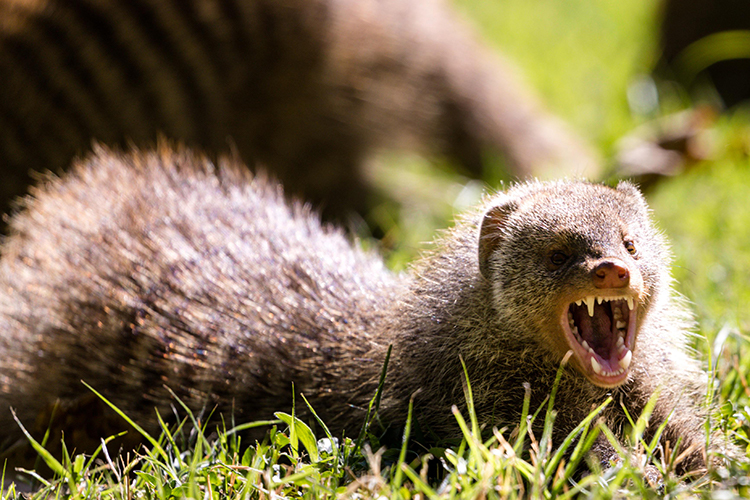
Mongooses are remarkable animals. They are intelligent, fast, and effective at certain tasks in nature. But human intervention — especially without consideration of the consequences — can easily lead to an ecological disaster.
If you want to learn more about these amazing creatures, it’s best to start with good documentaries — they allow you to see mongoose behavior in their natural environment and better understand how their lives work.
Cobra vs. Mongoose
In the video player, you can enable subtitles and choose their translation to any language in the settings.