Українська
  Русский
  Polski
  Deutsch
  Français
  Español
  Nederlands
  Svenska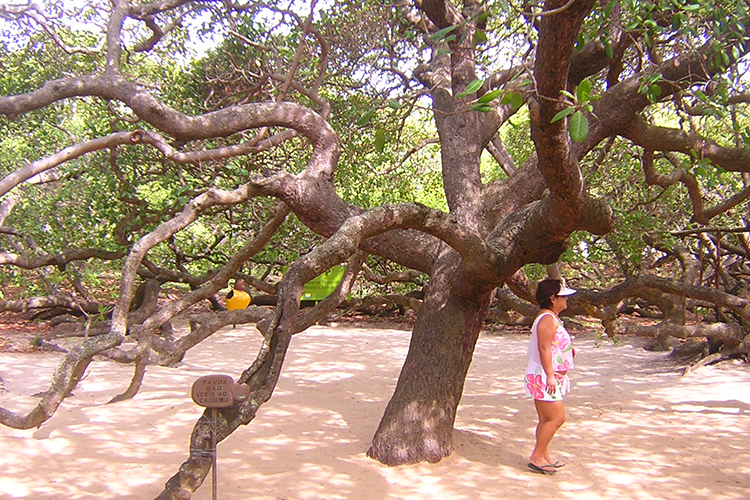
In Brazil, in the Pirangi do Norte area on the coast of Rio Grande do Norte State, there grows a unique cashew tree known as Cajueiro de Pirangi — the Pirangi Cashew Tree, or simply the Pirangi Cashew. It covers an area of about 8,500 square meters, which is approximately the size of a football field, and equals about 70 ordinary cashew trees by area.
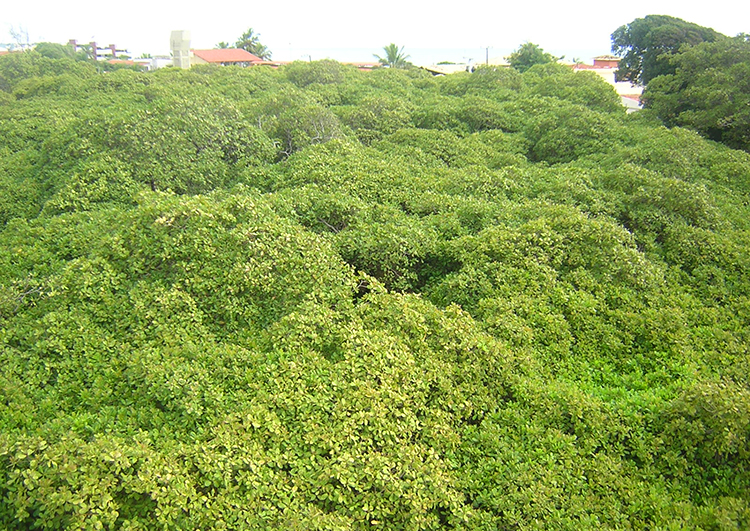
The Pirangi Cashew has spread so widely that from the outside it looks like an entire grove, although in reality it is a single organism. Its branches extend dozens of meters from the central trunk, forming a continuous green canopy. It is no surprise that this tree has become a famous landmark and attracts many tourists.
Interesting Fact
In 1994, the Pirangi Cashew was entered into Guinness World Records as the largest cashew tree in the world, and since then it has remained one of Brazil’s most astonishing natural attractions.
According to local legend, the giant cashew was planted as early as 1888 by a local fisherman named Luís Inácio de Oliveira. The tree’s exact age has not been established: some regard it as merely a centenarian long-liver, while others believe its unusual growth hints at an age of several hundred or even thousands of years.
Be that as it may, the tree yields an abundant harvest every year. Estimates suggest that tens of thousands of juicy cashew fruits are gathered per season — about 70,000–80,000 fruits a year (around 2.5 tonnes of cashew nuts).
Ripening occurs during the Brazilian summer (roughly from November to January), and tourists are free to collect fallen fruits — they are not sold but offered to visitors as a gift from nature.
Why the Tree Turned Into a Grove
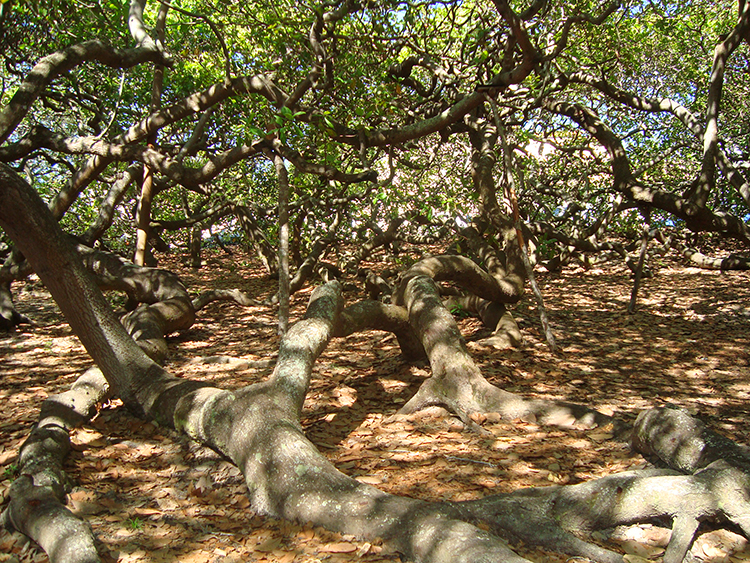
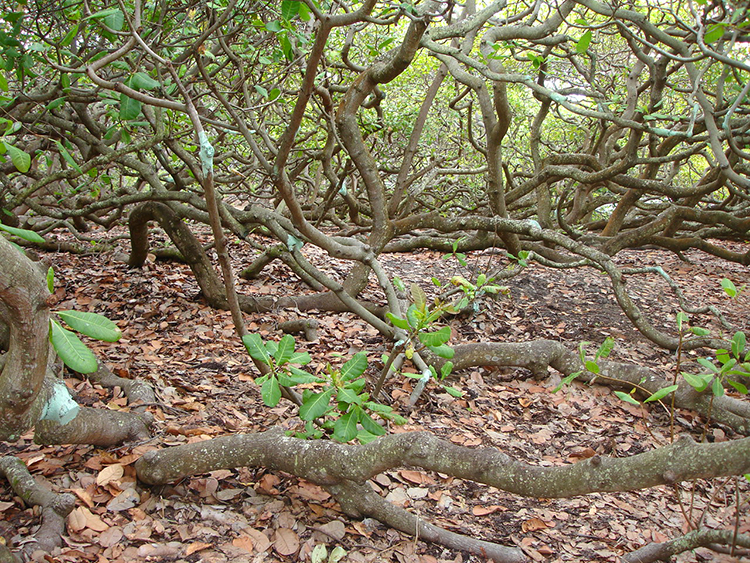
The tree’s gigantic size is explained by a rare genetic anomaly. In ordinary cashew trees, branches grow upward, but in the Pirangi Cashew they spread outward. As they expand horizontally, the heavy branches gradually bend under their own weight and sink toward the ground. Here a second anomaly manifests: as soon as a branch touches the soil, it takes root and then grows upward again, as if it were the trunk of a new tree. This cycle repeats over and over, so from the outside it appears as though a whole grove of cashew trees is growing side by side.
In fact, it is a single organism whose parts are interconnected by a common root system. Interestingly, a second (ordinary) cashew tree, planted slightly earlier than the giant, also grows within the park — however, 95% of the entire area is occupied by the anomalous giant cashew.
The record-holding tree’s main trunk branches into five large limbs. Four of them have “mutated” — that is, they possess the rooting ability described above — and they created the giant’s vast network of trunks and branches. Only one limb behaves normally and stopped growing when it reached the ground. Locals jokingly nicknamed this “modest” branch “Salário Mínimo” — which translates as “minimum wage.”
The rooted lateral branches provide additional feeder roots for the tree, but they do not penetrate deeply — usually only 1–2 meters into the soil. By contrast, the main trunk sent a root down about 20–25 meters, so the entire sprawling “grove” still critically depends on the central trunk.
This “phytoteratological” anomaly (as agronomists have called it, from the Greek for “plant” + “monstrous”) is extremely rare and has turned an ordinary cashew tree into a natural phenomenon.
Biologists believe that in the absence of barriers the tree could expand to 30,000–40,000 square meters — that is, to cover several hectares. In practice, however, such unchecked growth is impossible: the park with the giant cashew is surrounded by roads and residential areas that limit its further spread.
Tourist Attraction
Today, the Pirangi Cashew is protected by the state and has been turned into a small park. Thousands of tourists arrive here every year to see this wonder of nature.
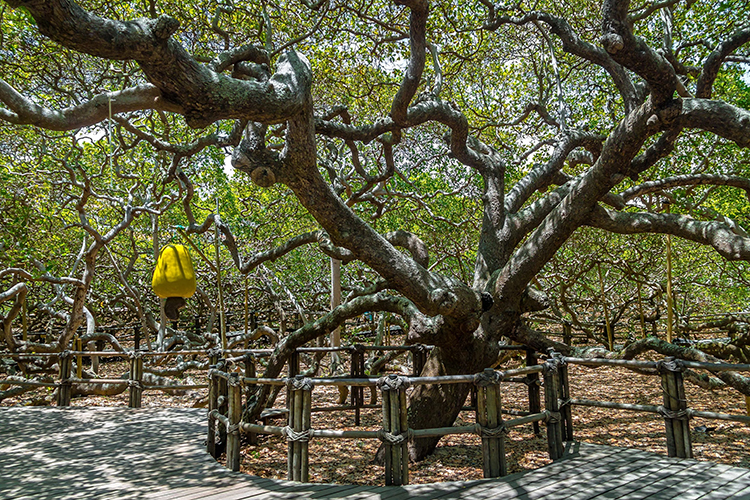
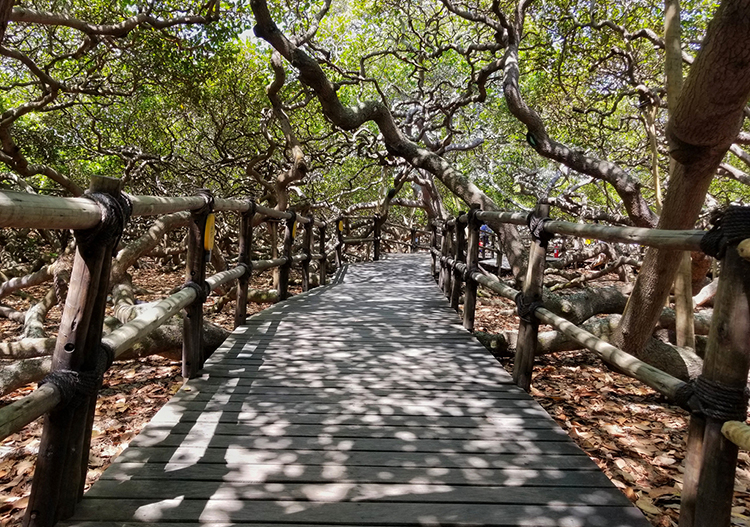
For visitors, boardwalks beneath the branches have been laid so people can stroll through the sprawling cashew as if it were a forest. In the center of the canopy there is a special viewing platform — a small tower that offers a panoramic view of the interlaced branches and the Atlantic coast.
Local guides tell visitors the tree’s story and explain its features. During the fruiting season, anyone can pick up a fallen cashew fruit — the bright yellow, juicy “cashew apple” — and even taste it.
Near the park entrance there is an alley of souvenir stalls: here they sell freshly roasted cashew nuts, local handicrafts, and all kinds of keepsakes for tourists. On the arch at the entrance stands the proud inscription “O Maior Cajueiro do Mundo” — “The Largest Cashew Tree in the World.”
To keep the tree and park in good order, a small entrance fee has been introduced (the proceeds go toward maintenance). Interestingly, the park has even added a modern service — free Wi-Fi under the canopy — so visitors can share their impressions online right away.
The enormous cashew tree has become a symbol of the area: along the highway leading to it, signs shaped like a cashew nut are installed, and one local cachaça brand (the national spirit) releases a special cashew-flavored variety. Both Pirangi Beach and the giant tree have fitted perfectly into the region’s tourism industry, boosting its worldwide recognition.
The Problem of Overgrowth and Pruning
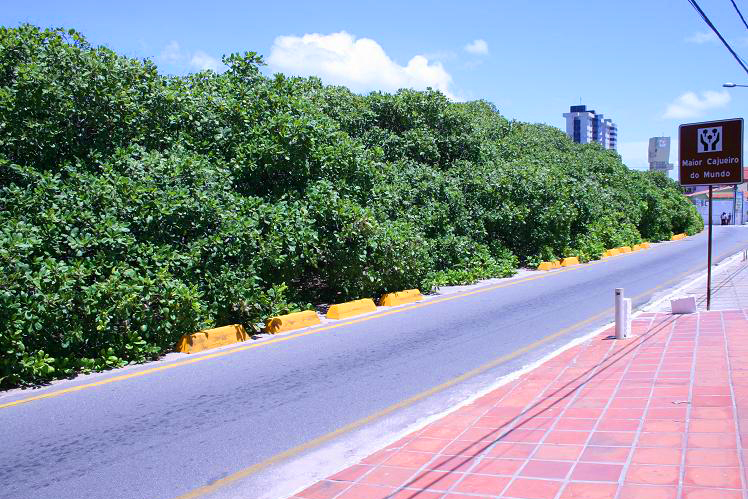
The rapid growth of the giant cashew tree also creates difficulties for local residents. Over time, the tree’s branches began to extend beyond the park’s borders. On one hand, everyone understands that the “green record-holder” must be protected — after all, it is among the main tourist attractions of the state. On the other hand, the sprawling branches began to hang over nearby roads and buildings. In particular, the giant cashew has grown right up to the Rota do Sol (“Road of the Sun”) highway leading to the southern beaches, and during rush hours its broad canopy has caused traffic jams. In addition, residents of nearby houses fear that the expanding branches could eventually damage their properties. This has raised a controversial question: should the tree be pruned?
Opinions among locals are divided. Some residents and city officials insist on pruning: in their view, this would free the road, prevent congestion, and protect nearby houses. Others are strongly opposed, as no one knows how the cashew tree would react to such interference. There is a risk that disturbing its structure could lead to disease or even the death of the tree, which would be a loss both for nature and for the tourism industry.
Discussions on this issue have been going on for several years. The authorities are seeking a compromise: as early as 2012, a special support frame (portal) was installed along the highway to hold up the overhanging branches and keep them from obstructing traffic. So far, direct pruning has been avoided, and the giant cashew continues to grow within the limits of its park boundaries.
How to See This Natural Wonder
The Pirangi Cashew Tree is located in the municipality of Parnamirim, about 12 kilometers south of Natal, the capital of Rio Grande do Norte State. The tree is open to visitors daily from 7:30 a.m. to 5:30 p.m. The best time to visit is from December to March, when the tree bears fruit and visitors can taste fresh cashew apples.
For those who cannot visit the tree in person, there are videos and virtual tours that allow you to see this natural wonder in all its beauty. At the end of the article, you will find video reports showing the scale of this amazing tree.
To switch to full screen mode, press the "Toggle Full Screen" button in the top right corner (if this button is not visible, turn your mobile device to landscape orientation).
The Dispute Over the Title of the World’s Largest Cashew Tree
The status of the Pirangi Cashew Tree as the world record-holder has been challenged. In another Brazilian state — Piauí, on the coast of the municipality of Cajueiro da Praia — there grows another giant cashew tree that locals have named Cajueiro-Rei (“Royal Cashew”).
The residents of Piauí claim that their tree is actually larger than the famous cashew of Rio Grande do Norte. In 2015–2016, a scientific expedition was organized: specialists from the State University of Piauí carefully measured the crown area of the competitor and even conducted a genetic analysis to confirm that the spreading grove is indeed a single tree, not several fused together.
The study results surprised many: the area of the Piauí tree turned out to be about 8,800 m², that is, approximately 300 m² larger than the Pirangi Cashew. Moreover, the age of the contender is estimated at about 200 years (it grew from a single seed in the early 19th century), which makes it significantly older than the century-old tree on Pirangi Beach.
Officially, the title of the world’s largest cashew tree still belongs to the Cajueiro de Pirangi — it is still the one listed in the Guinness World Records. However, the Piauí authorities are confident that this is only a matter of time. The State Secretary of Tourism of Piauí, Flávio Nogueira, stated that after obtaining scientific proof, they would submit an application to Guinness World Records to challenge the existing record. According to him, winning the title would attract a flow of tourists to the region and boost the economy, so they are determined.
In October 2017, the results of the Piauí tree study were published in an international scientific journal, and the tree itself received protected status and is actively preparing for worldwide recognition.
Today, Cajueiro-Rei in Piauí has already become a popular tourist attraction, even without an official record. Locals treat their giant with care: back in 2013, the tree was declared a natural and tourist heritage site of the municipality. Under the crown of the “royal” cashew, ecological trails with guides have been laid, and at the entrance there is an information center for visitors.
The tree’s area is now estimated at about 8,830–8,834 m², and each year it produces up to 90,000 cashew fruits — slightly more than its “colleague” in Rio Grande do Norte. Local producers use the harvested fruits to make traditional beverages such as cajuína — a natural, clear juice made from cashew fruit, while the nuts are roasted and sold. Thus, even without an official world title, the Piauí giant cashew already benefits both people and nature.
Despite the dispute over the title, both Brazilian cashew trees — the Pirangi Cajueiro de Pirangi and the Piauí Cajueiro-Rei — are truly astonishing creations of nature. Their unique growth, impressive size, and generous harvests make them living natural landmarks.
And for us, the viewers, perhaps it does not really matter which one is larger by a few hundred meters: what matters far more is the miracle itself — the opportunity to walk beneath the canopy of the largest cashew tree in the world, to feel like part of this fairy-tale grove, and to marvel at the endless diversity of nature.
Pirangi Cashew Tree — The Largest Cashew Tree in the World
In the video player, you can enable subtitles and choose their translation to any language in the settings.
In the video player, you can enable subtitles and choose their translation to any language in the settings.
Royal Cashew — A Contender for the Title of “The Largest Cashew Tree in the World”
In the video player, you can enable subtitles and choose their translation to any language in the settings.
In the video player, you can enable subtitles and choose their translation to any language in the settings.