Українська
  Русский
  Polski
  Deutsch
  Français
  Español
  Nederlands
  Svenska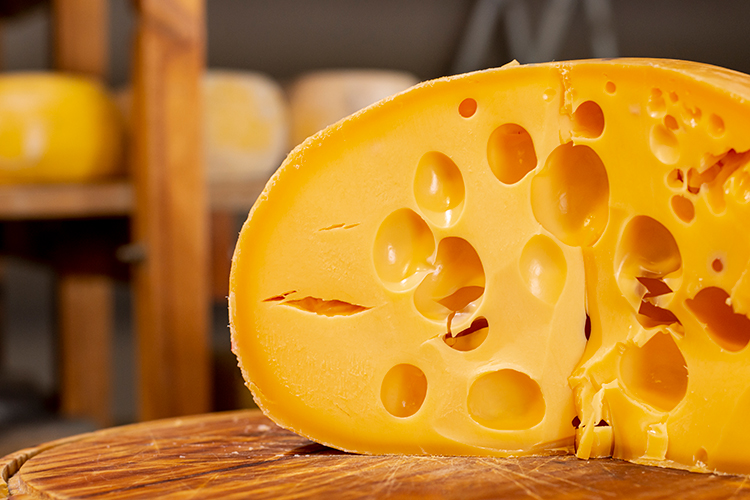
Have you ever wondered why some cheeses are literally filled with holes? These openings can vary in shape and size: sometimes they are large and round, while other times they are small and oddly shaped. The mystery of this cheesy phenomenon turned out to be so intriguing that scientists puzzled over it for nearly a century. Let’s find out why the famous cheese holes appear and what determines their size and quantity.
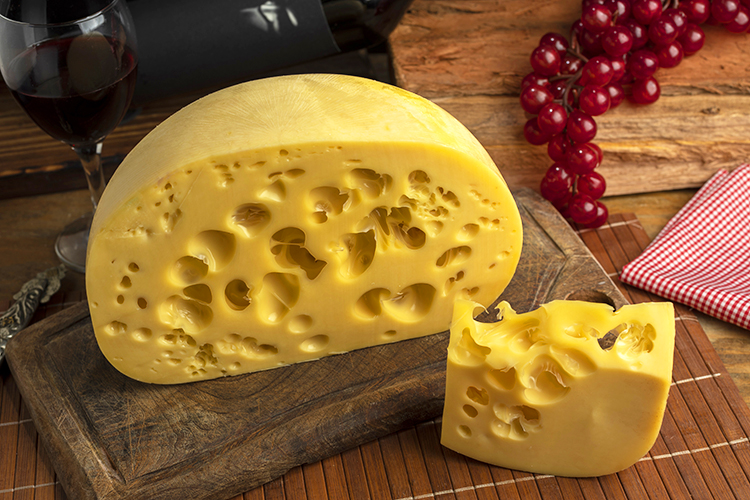
In short, cheese holes (also called “eyes”) are bubbles of carbon dioxide trapped inside the cheese wheel. Thanks to these bubbles, well-known Swiss cheeses like Emmental or Appenzeller—and even some Dutch varieties like Maasdam or traditional Gouda—feature their distinctive holes.
But where does the carbon dioxide in cheese come from and why do some cheeses have large round holes while others barely show any? The story of finding the answer goes back in time and leads us to a very recent scientific discovery.
Old Explanation: Gas-Releasing Bacteria
Until recently, there was a simple explanation: cheese holes were thought to be the result of bacterial activity. Microorganisms introduced into the cheese milk produce carbon dioxide during the ripening process, which accumulates inside the cheese mass and forms bubbles. This theory originated in the early 20th century. In 1917, American researcher William Clark was the first to study cheese holes in detail and concluded that they were indeed formed by CO₂ bubbles released by bacteria in the milk. This theory gained traction and became the commonly accepted explanation for decades.
For nearly a century, the idea of “bacterial bubbles” went unchallenged. Cheesemakers knew that special bacterial cultures were needed to produce cheese with eyes, and it was assumed that the more active the bacteria, the more holes there would be. Among the general public, the image of holey cheese was firmly associated with microbes—or, humorously, with mice supposedly gnawing tunnels through the cheese.
However, the exact mechanism behind the formation of neat, round eyes in cheese wheels remained a mystery. Why does the gas accumulate in distinct large cavities instead of spreading evenly throughout the cheese? Why do some cheeses turn out “blind” (without holes) even when bacteria are present? These questions remained unanswered for a long time.

New Discovery: Hay Microparticles
Recently, scientists managed to look at the issue from a different angle—and they made a surprising discovery. In 2015, a group of Swiss researchers from the Agroscope state center reported that the old theory was incomplete. As reported by The Guardian, the true reason behind the famous Swiss holes wasn’t just bacteria. The real “culprits” turned out to be... microscopic hay particles that end up in the milk!
How are hay and cheese connected? As it turns out, quite simply. Traditionally, milk for cheesemaking was collected on farms in open buckets directly in the barn. While milking the cow, tiny particles of dry grass—essentially hay dust—could fall into the warm milk from the surrounding air. Swiss experts noticed an interesting pattern: if there were many such particles in the milk, the resulting cheese developed large holes during aging; but if the milk was perfectly clean, without any grass dust, the cheese came out almost holeless.
The researchers conducted experiments by adding different amounts of “hay dust” to the milk and confirmed: more hay microparticles = more cheese holes. These tiny bits of dry grass act as “seeds” for hole formation.
How does it work? Lactic and propionic bacteria in the cheese still produce carbon dioxide during the aging process—that part hasn’t changed. But in clean milk, the gas simply dissipates and gradually escapes from the cheese wheel without forming large cavities. If hay microparticles are present, gas begins to accumulate around them, forming a bubble.
The thing is, dry plant material has a porous structure and contains microscopic air pockets inside. So, each speck of hay becomes a perfect spot where CO₂ can start to collect. As the cheese ripens, the bubble around the grass fragment grows, pushing the surrounding cheese mass outward. This is how the iconic round “eyes” gradually develop. In the end, hay determines the location and shape of the future holes, while the gas is provided by bacteria.
Swiss researchers even used computer tomography to scan cheese wheels during aging and track the formation of holes. The results confirmed the hypothesis: neat, round cavities appeared in places where microscopic bits of dry grass were present in the cheese mass. Without hay, the cheese either remained “blind” or developed only small, irregular voids.
It turns out that the old belief was only partially true: bacteria do indeed produce carbon dioxide, but only the presence of tiny hay specks gives the gas “collection points” and shapes the proper holes.
Where Did the Holes Go? Modern Hygiene vs. Tradition
The discovery also explained another mystery: why many cheeses have developed fewer holes in recent decades than before. As technology advanced, farmers gradually stopped using open buckets for milking. Modern milking machines collect milk directly from the udder in a sealed system, preventing external contamination. From a hygiene standpoint, this is excellent — the risk of unwanted microbes is minimal. But a side effect has been the disappearance of those tiny hay particles that used to inevitably end up in fresh milk in the old days.
Swiss experts have noted that over the past 10–15 years, the size and number of holes in local cheeses have noticeably decreased. The reason lies in the disappearance of the traditional open milk collection method. When “the good old bucket” was replaced with sterile pipelines, cheese began to ripen without the familiar “seeds” for eyes.
If you buy modern Emmental in a store, you may notice that its holes are often not as large as those in the classic “cheese wheels” seen in vintage images. Producers jokingly say that modern cheese has become too clean, and some even add a pinch of sterile “hay powder” to the milk to restore the cheese’s traditional appearance. (In Switzerland, such additives are banned by standards, but some cheesemakers in other countries use them to achieve large holes.)
It’s important to understand that bacteria cannot be eliminated entirely: without gas-producing bacteria, there would be no cheese holes at all. So the discoveries made by Swiss scientists do not disprove the role of microbes — they complement it. It was simply overlooked before that the natural non-sterility of milk also played a beneficial role. In traditional cheesemaking, a small pinch of hay in the milk turned out to be just as essential to “proper” cheese as the bacterial cultures themselves.
Summer vs. Winter: How Animal Feed Affects Eye Formation
Interestingly, the new theory also helped explain other observations made by cheesemakers. For example, it used to be unclear why cheese made in the summer typically has fewer holes than winter cheese. Now it all makes sense.
In summer, cows (and goats) eat fresh, juicy grass, and during milking, there are almost no dry particles that could get into the milk. As a result, milk in the warm season is cleaner from “hay” debris, and the cheeses turn out denser and often completely holeless (for instance, Alpine Gruyère is traditionally made in summer and has no holes). In winter, however, the animals are fed dry hay, which is always accompanied by dust. During hand milking indoors, tiny pieces of dried grass inevitably end up in the milk. That’s why winter cheeses tend to be the most holey — they contain far more “seeds” for gas bubbles.
Experienced cheesemakers were aware of this effect even before science confirmed it. In some regions, it was customary to make the best cheeses intended for long aging with summer milk (which was cleaner). Winter batches, rich in eyes, were consumed more quickly or used for other purposes. Now we know the scientific explanation: the number of holes directly depends on what the animals ate and how much dry matter ended up in the milk.
Why Do Different Cheeses Have Different Holes?
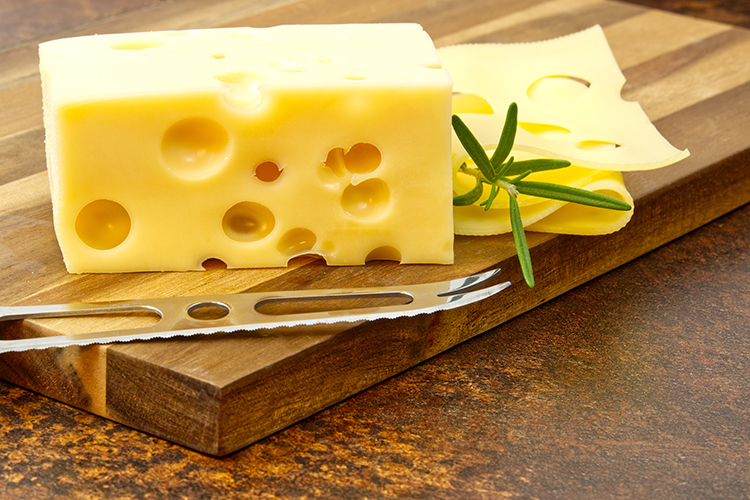
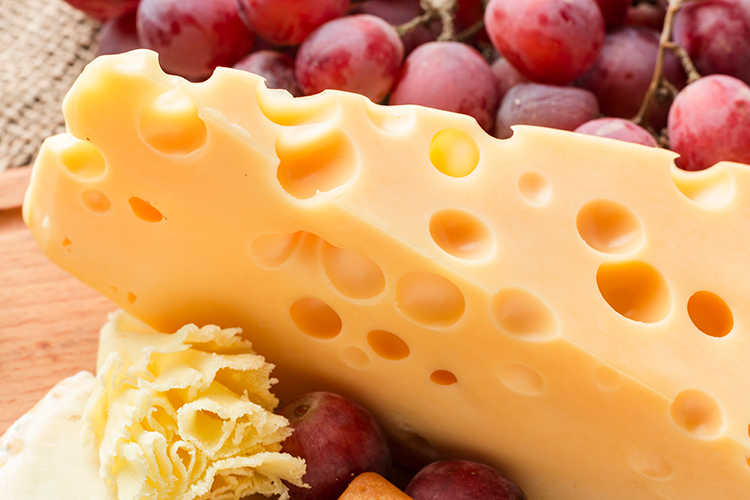
Even within the same season, different types of cheese vary in how “holey” they are. Some have giant eyes, others tiny ones, and some have none at all. For instance, in the popular Russian cheese “Rossiyskiy,” the holes are very small and irregular; Dutch Gouda has slightly larger and more evenly shaped holes; while Swiss Emmental or Dutch Maasdam have massive ones. What determines this?
The fact is, many production factors influence the size and number of holes. Here are the key ones:
- Consistency and Moisture Content of the Cheese Mass. Cheeses with a softer and more elastic texture (such as young semi-hard cheeses) are better at retaining a gas bubble, which stretches the mass and forms a round cavity. If the cheese is very hard or dry, it’s difficult for the gas to form a large bubble — excess pressure is more likely to cause cracks or escape entirely without forming eyes.
- Milk Composition and Production Technology. Everything matters: how much milk is used per wheel, its fat content, whether cream is added or skimmed, how much salt is added, what spices or additives are used. The pressing method also plays a role: heavily pressed cheese (like cheddar) leaves almost no space for bubbles to form, while in lightly pressed cheeses, small gaps remain between the curd grains where holes can begin to form. Temperature and ripening duration also affect the outcome — some cheeses are aged in warm rooms specifically to stimulate eye formation.
- Bacterial Cultures and Recipes. Different cheeses are made with different microbes and fermentation conditions. Swiss varieties specifically include propionic bacteria, which release a lot of CO₂ — that’s why Emmental and Maasdam develop many large holes. By contrast, classic Gouda uses entirely different cultures: they ferment citric acid instead of lactose and produce very little gas, so Gouda typically ripens almost without holes (sometimes just a couple of small eyes). Many traditional hard cheeses (Parmesan, Cheddar, Gruyère) are intentionally made with minimal gas production — resulting in a dense structure without cavities.
As a result, each cheese matures according to its own script. Even if two cheeses start with the same milk containing a “hay speck,” other differences — in bacteria, salt, pressing, etc. — will cause gas formation to proceed differently. That’s why “holeyness” is a unique trait of each cheese variety, just like flavor or aroma.
For example, large factories today produce cheese in highly controlled conditions. The milk is purified, starter cultures are measured precisely — such processes yield predictable results. Industrial cheeses most often come out either completely without eyes or with small, neatly formed holes.
On small farms and home creameries, where traditional methods and less sterile ingredients may be used, cheese wheels often end up with those classic large “eyes” — just like in the old days.
Both approaches are valid — each producer strives for their own ideal. In some places, consumers prefer large holes (as a sign of “real” rustic cheese), while in others, a uniform texture without any cavities is valued more.
Fun Fact
A century ago, large holes in cheese were often considered a defect that could ruin the product’s taste and texture. Cheeses with overly large eyes were rejected, as they were suspected of being overripe or poorly made. However, over time, those big round holes became a hallmark of certain cheeses and earned them global fame.
Today, it’s hard to imagine Emmental or Maasdam without their cheerful holes — sometimes flaws of the past turn into charming features that delight both gourmets and knowledge seekers.