Українська
  Русский
  Polski
  Deutsch
  Français
  Español
  Nederlands
  Svenska
 Nature is not just a backdrop for our travels: it can astonish so much that it makes us laugh, freeze in place and think. Among the vast green expanses of our planet, there are places so bizarre that it seems they are not forests but fantasies brought to life.
This selection features four truly unusual forests: crooked pines in Poland, the oldest living organisms in the USA, black tree “skeletons” in Namibia and a giant tree-grove in Brazil. Each of them is not only a spectacular sight but also a mystery of nature. Why did the trunks bend? How can an entire grove be a single tree? And what destroyed a forest, leaving behind nothing but bare remains?
Crooked Forest, Poland
To enlarge, press the image | shutterstock.com
To enlarge, press the image | stock.adobe.com
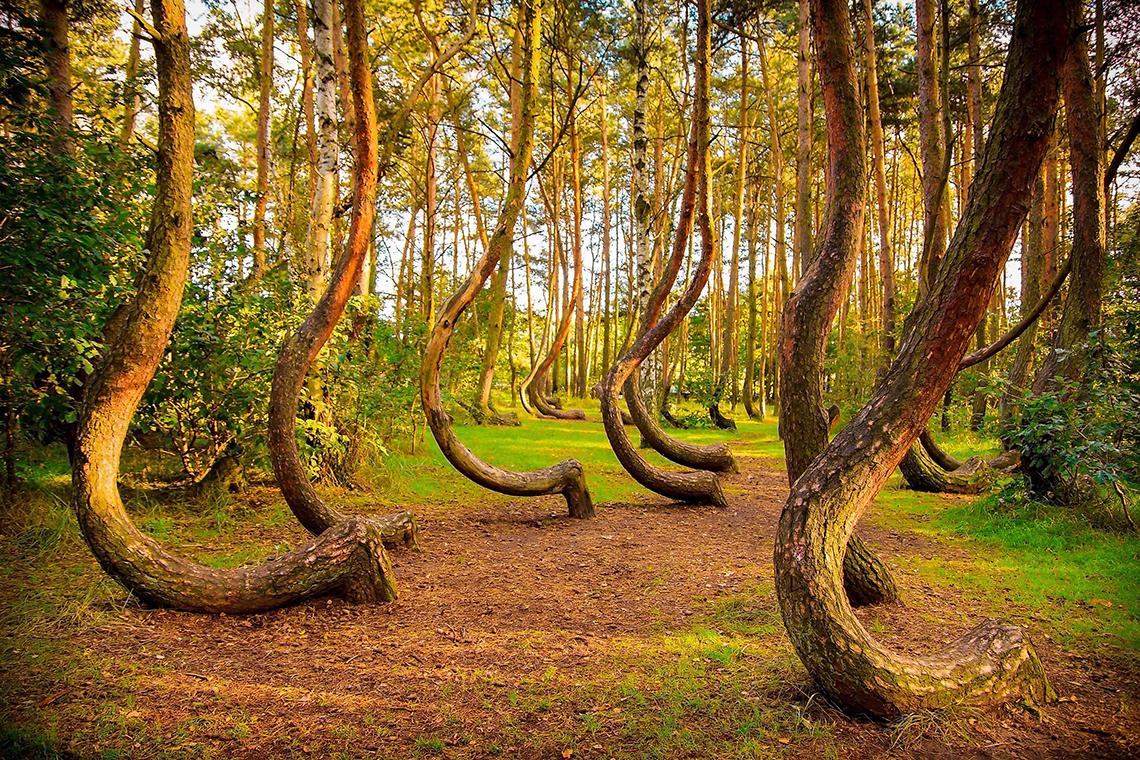
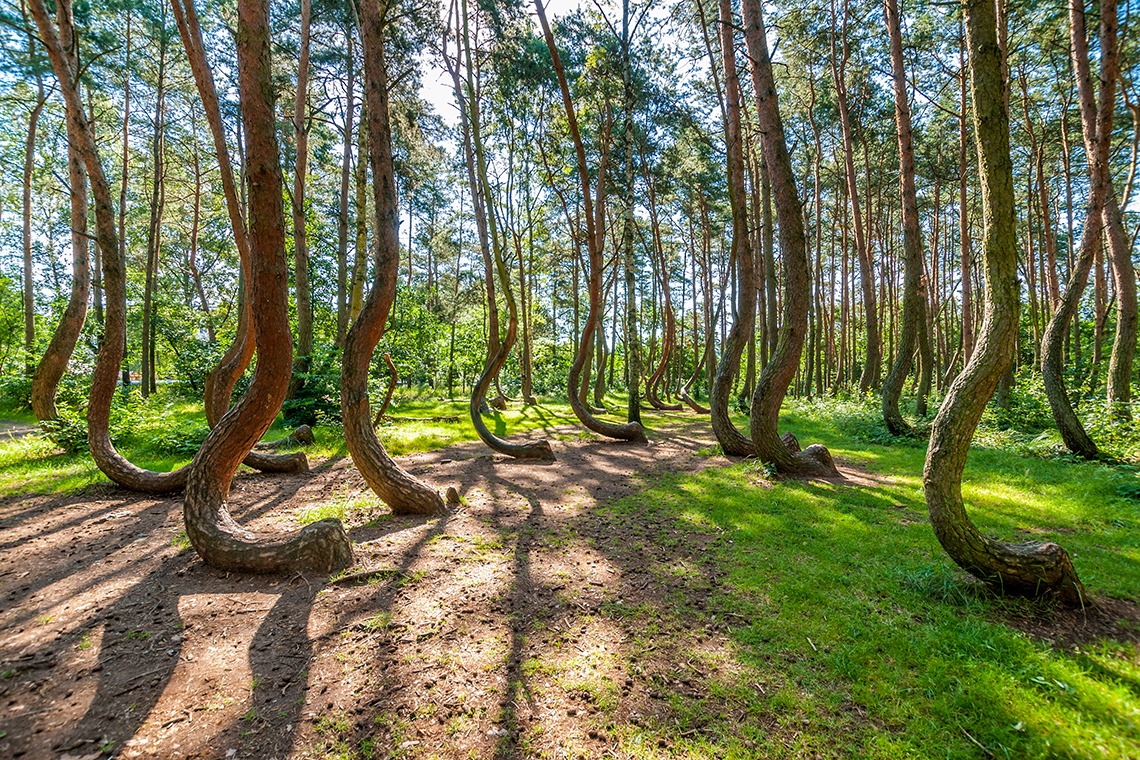
The Crooked Forest, also known as the “Curved Forest,” is a grove consisting of a group of strangely bent pine trees. This forest is located in northwestern Poland, in the village of Nowe Czarnowo near the town of Gryfino, West Pomeranian Voivodeship. It is a tourist attraction in the region and a protected natural monument of Poland.
This grove of 400 pines was planted around 1930. Each pine bends sharply to the north just above ground level and then returns to a vertical position after a sideways deviation at a height of 1–3 meters. The crooked pines are surrounded by a normal forest of straight pines. The total area of the Crooked Forest is about 1.7 hectares.
It is widely believed that some kind of human tools or techniques were used to force the trees to grow or bend in such a way, but the exact method has never been identified and remains a mystery to this day.
One theory suggests that the trees were intentionally shaped by people who practiced this specifically to create curved wood for carpentry or shipbuilding purposes, such as for making furniture, boats, sleds and so on. Others assume that a snowstorm may have bent the trunks, but there is little evidence to support this.
The Crooked Forest was featured in Episode 4, Season 1 of the History Channel series The UnXplained, in an episode titled “Unnatural Nature,” which first aired on August 9, 2019.
More fascinating facts, photos and videos about this forest can be found in our article “The Crooked Forest in Poland: The Mystery of Bent Pines.”
Dead Forest of Deadvlei, Namibia
To enlarge, press the image | shutterstock.com
To enlarge, press the image | pexels.com
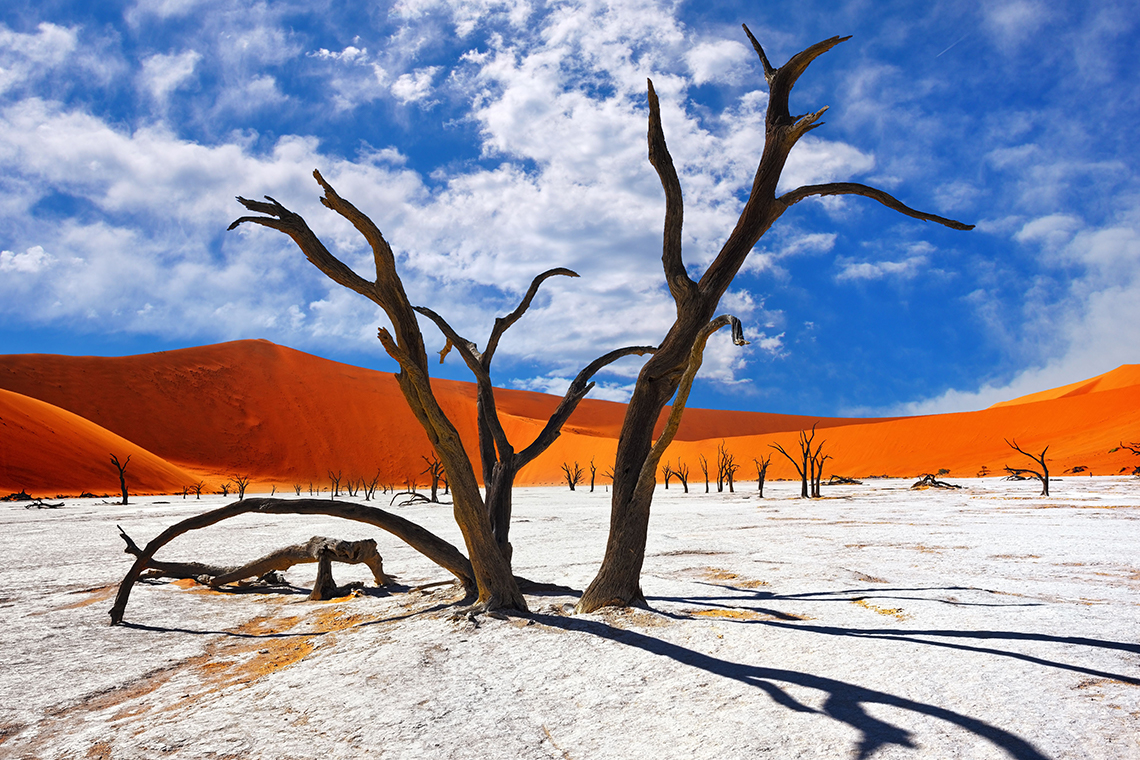
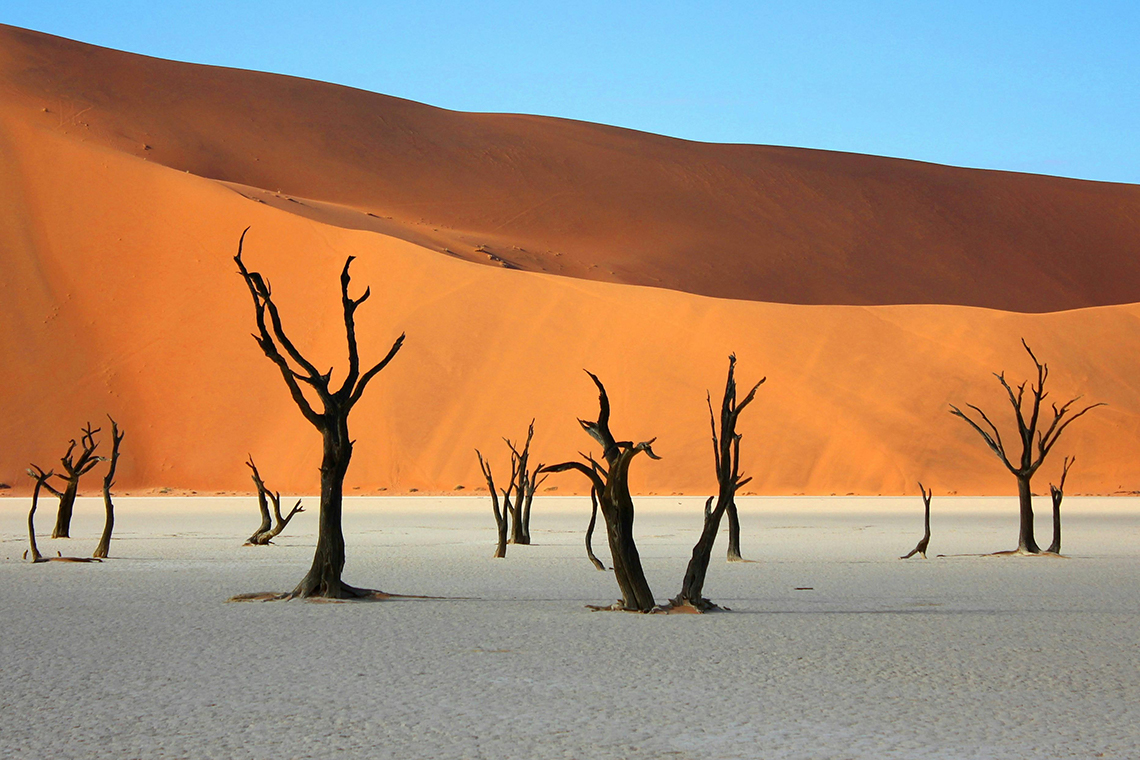
The Deadvlei Forest is located in the middle of the desert and consists of dark dead camel thorn trees that contrast sharply with the white clay pan of Deadvlei. It is situated near the famous Sossusvlei salt pan in Namibia.
The clay “pan” of Deadvlei and its forest formed after rainfall, when the Tsauchab River flooded and an abundance of water allowed camel thorn trees to grow. However, the climate changed, drought struck the region and sand dunes invaded the area, preventing the river from reaching it. The age of the trees in this forest is estimated at about 700 years, yet they have not decomposed due to the extremely dry climate.
Deadvlei is a paradise for photographers, as the contrast between the pitch-black trees and the bleached clay surface, rust-red dunes and deep blue sky creates incredible images. Deadvlei is located at least 1 kilometer on foot from the parking area, so be sure to bring drinking water.
The opportunity to walk among these incredible tree skeletons, as well as more facts and photos about this place, can be found in our article “The Unique Deadvlei Forest in Namibia: Trees Frozen in Time.”
Ancient Bristlecone Pine Forest, USA
To enlarge, press the image | wikimedia.org
To enlarge, press the image | rawpixel.com
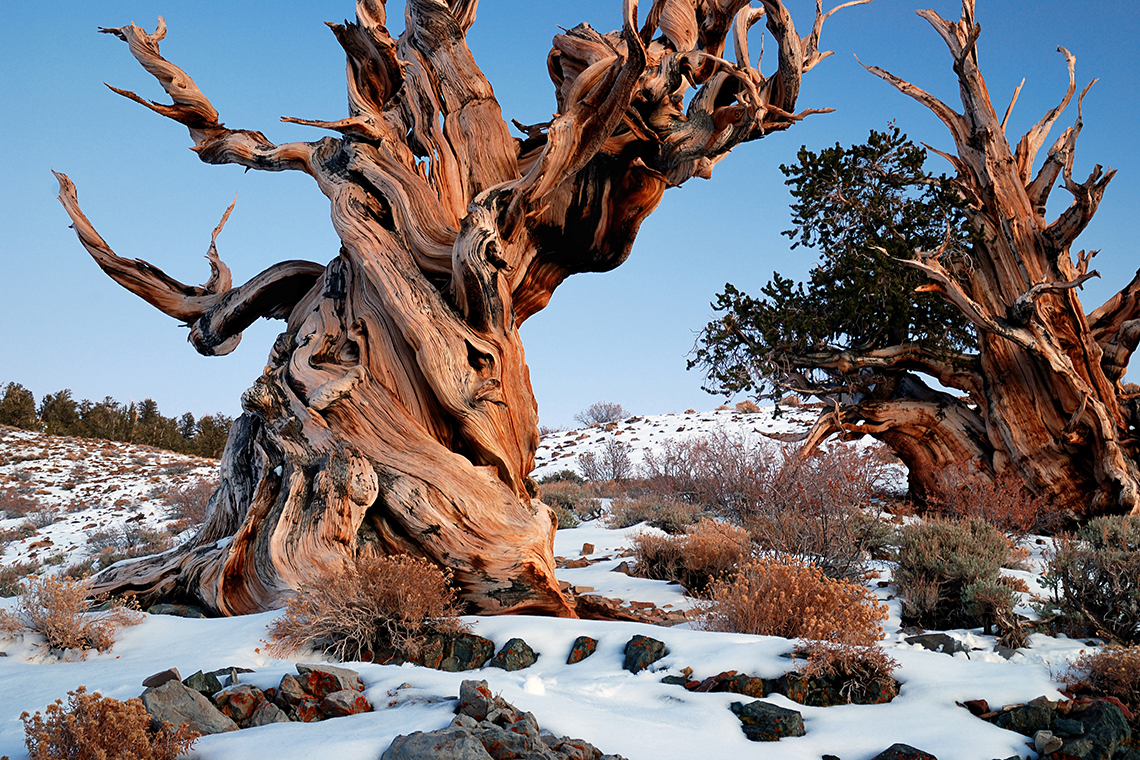
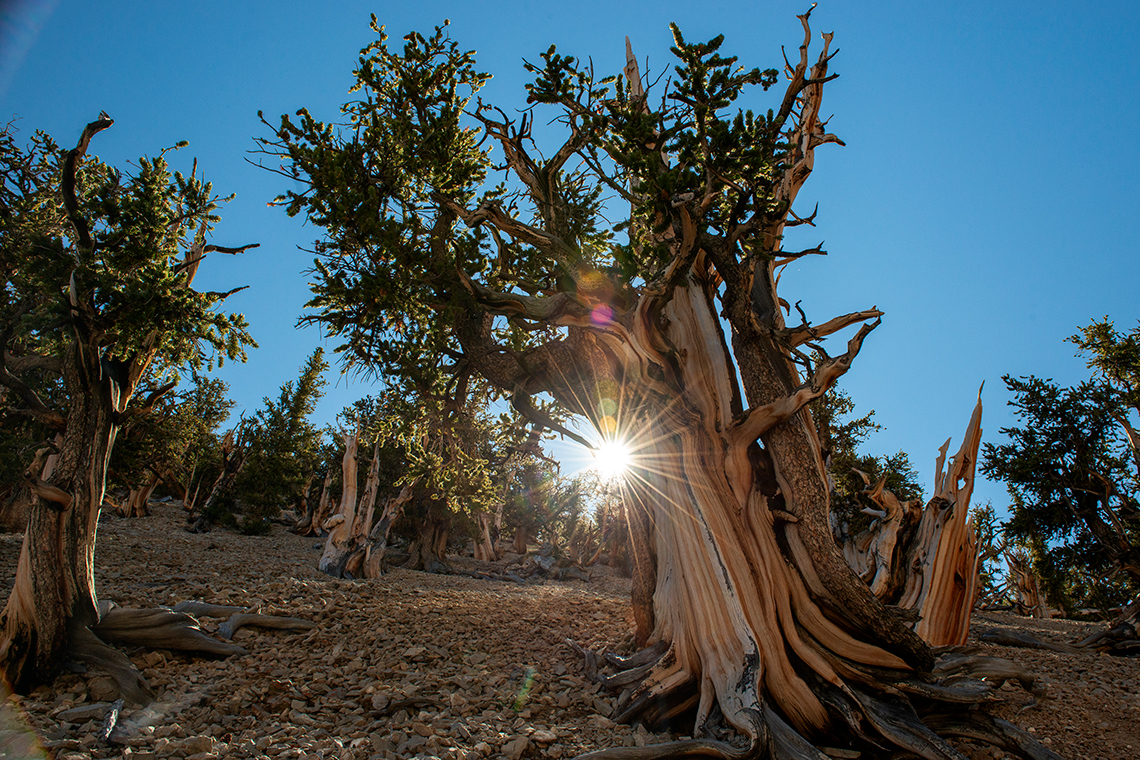
The Ancient Bristlecone Pine Forest is a protected area high in the White Mountains of Inyo County in eastern California, USA. This forest is home to Great Basin bristlecone pines, which are known for their extremely long lifespan — up to several millennia.
These trees have gnarled, stunted trunks, especially those growing at higher elevations.
The most remarkable place in the Ancient Bristlecone Pine Forest is the Methuselah Grove. This is where the Methuselah Tree grows — the oldest living organism on Earth. The exact location of the Methuselah Tree is kept secret to provide additional protection from vandals.
The Ancient Bristlecone Pine Forest is typically open from mid-May to late November, weather permitting.
More fascinating facts about this extraordinary forest and the Methuselah Tree can be found in our article “Bristlecone Pine Forest: The Oldest Forest on the Planet.”
The Cashew Tree-Grove, Brazil
To enlarge, press the image | shutterstock.com
To enlarge, press the image | wikimedia.org
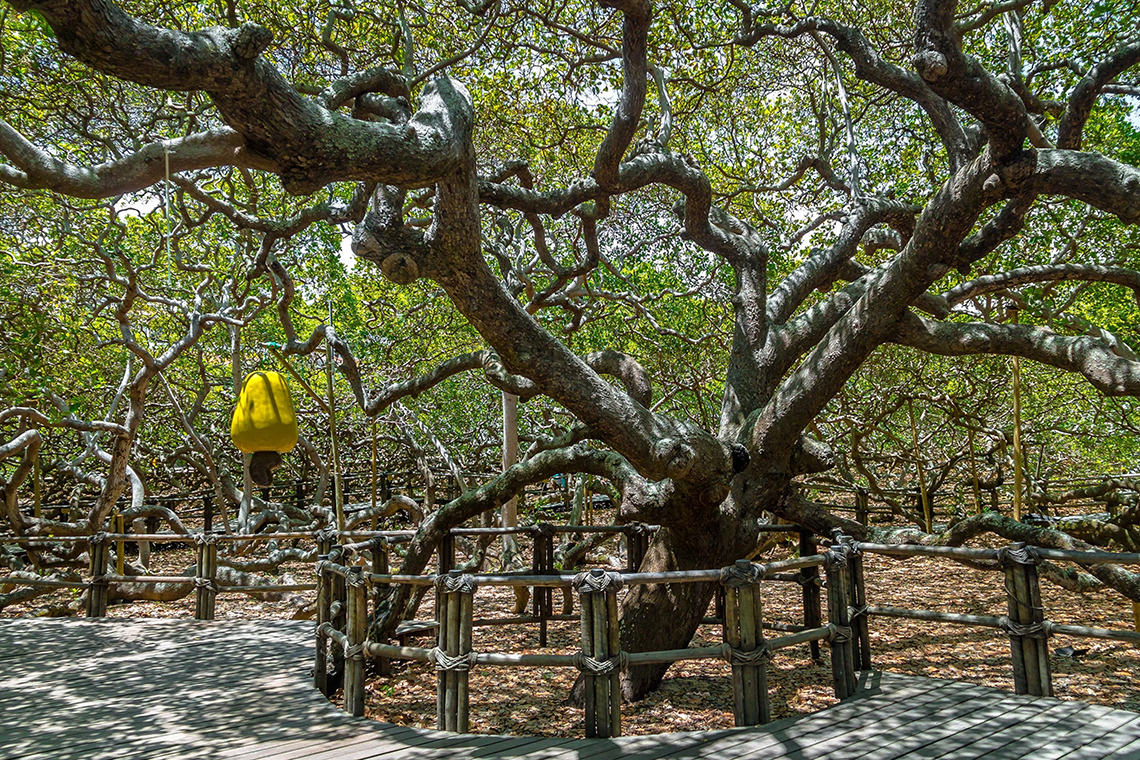
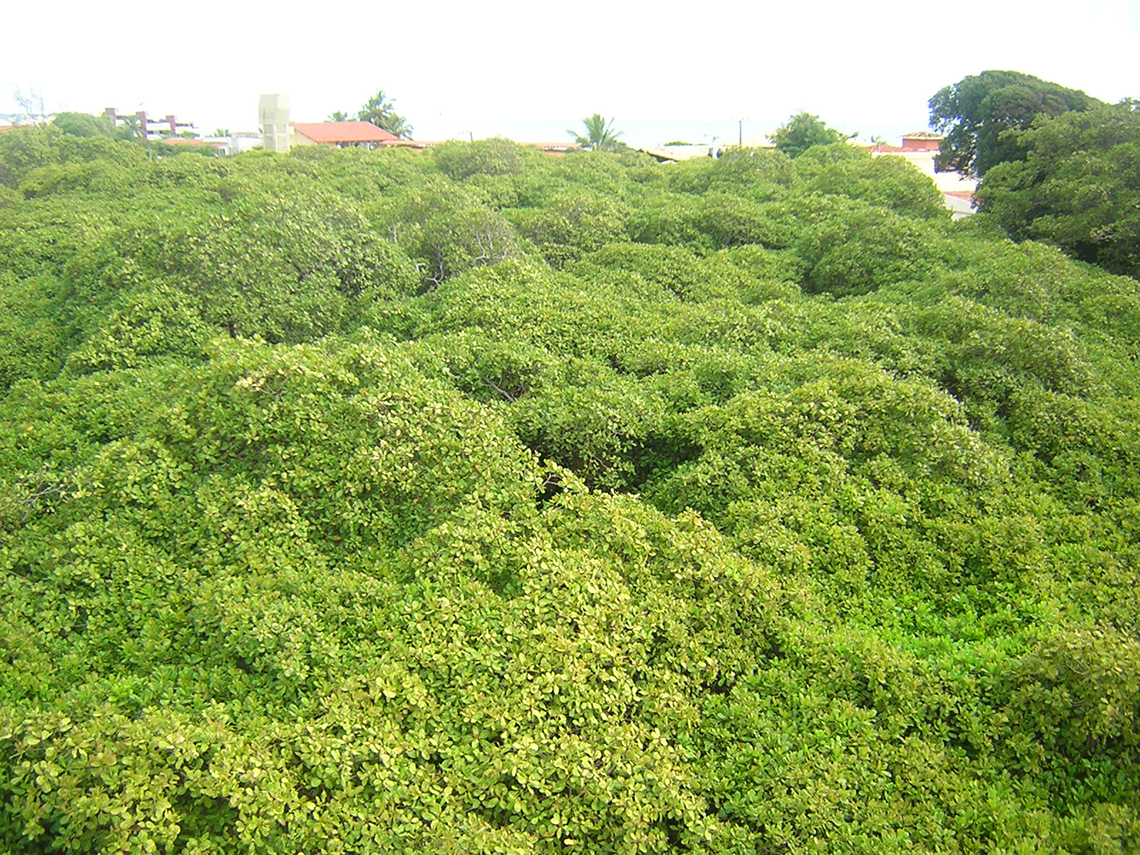
Strictly speaking, this is not a forest but a grove. However, what makes it astonishing is the fact that this entire grove consists of just one tree — the Pirangi Cashew (Cashew of Pirangi). This giant tree is known as the largest cashew tree in the world, covering an area of nearly 1 hectare.
The Pirangi Cashew grows in eastern Brazil, on Pirangi Beach near the city of Natal. It is a popular local tourist attraction. Walkways are built among the branches for visitors, and there is a viewing platform near the tree that is very popular with tourists.
Instead of growing upward, the branches of this tree spread outward and eventually bend down under their own weight. When the branches touch the ground, they take root and then begin to grow again — as if they were the trunks of another tree.
According to biologists, if the tree continues to grow without obstruction, it could expand to an area of 40,000 m². However, for many years its growth has been limited by the surrounding streets.
The Pirangi Cashew occupies an area of about 8,500 square meters (0.85 hectares), and the circumference of the tree, including all of its branches, is 488 meters. Its size is equivalent to 70 ordinary cashew trees. Each year, it produces around 75,000 cashew nuts, which is roughly 2.5 tons.
More interesting facts, photos and videos about this football-field-sized tree can be found in our article “Pirangi Cashew Tree: The Giant Tree-Grove in Brazil.”