Українська
  Русский
  Polski
  Deutsch
  Français
  Español
  Nederlands
  Svenska
Until the mid-20th century, writing was a messy and troublesome task. Traditional fountain pens constantly needed refilling and often leaked, while ink dried slowly on paper and smudged easily. Writers of that era frequently complained that sharp nibs scratched the paper, splattered ink, and tore the sheet. All this drove inventors to search for a more reliable and cleaner writing tool.
The First Attempt: John Loud’s Patent (1888)
The first step toward the ballpoint pen was made by American inventor John J. Loud. On October 30, 1888, he received a patent for a pen with a fundamentally new tip. Instead of a sharp nib, Loud used a small steel ball mounted in a socket at the tip of the pen. As the pen moved, the ball rotated and was supposed to pick up ink from an internal reservoir and apply it continuously to the surface. Loud's idea was to make it possible to write even on rough materials (such as leather), where a fountain pen was useless.
However, his device encountered serious problems — the ink flowed inconsistently, and the lines were too thick. Loud’s pen turned out to be unsuitable for neat writing on paper, so the invention never went into mass production, and the patent soon expired.
Loud never managed to perfect his idea — perhaps that’s why today we talk about “Biro” pens instead of disposable “Louds.”
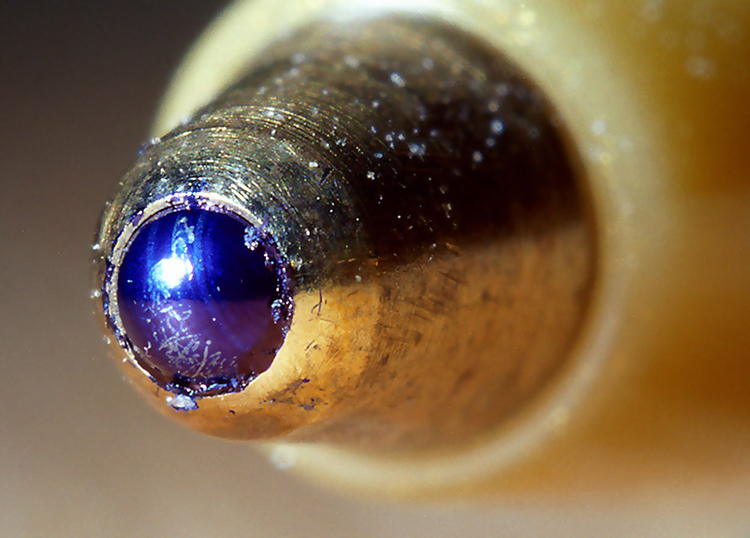
Highly magnified image of a ballpoint pen tip: the tiny ball that rotates in the socket and applies ink to paper is clearly visible | wikimedia.org
Laszlo Biro’s Breakthrough: The Birth of the Ballpoint Pen
A true revolution was made by Hungarian journalist László József Bíró (1899–1985). While working as a reporter, he noticed something interesting: newspaper ink dried almost instantly without smudging, whereas fountain pen ink took time to dry. A simple question occurred to Bíró: could a pen be created that used the same quick-drying ink?
The problem was that thick printing ink couldn’t flow through a narrow fountain pen nib. So Bíró, together with his brother György (a chemist by profession), came up with the idea of replacing the nib with a tiny ball bearing.
The idea was that a metal ball would rotate freely in the pen tip and, as it moved, pick up a portion of thick ink paste from the reservoir, transferring it evenly onto the paper. This simple yet brilliant mechanism made it possible to use more viscous, fast-drying ink without leaks.
Bíró presented his prototype to the public at the Budapest International Fair in 1931. A few years later, in 1938, he patented his invention, laying the foundation for the modern ballpoint pen.
Wartime and Early Success
The spread of this innovation was accelerated by dramatic events. In the late 1930s, the situation in Europe was becoming tense, and as a Jew, László Bíró was forced to emigrate. In 1943, he and his brother moved from Hungary to Argentina, where they founded Biro Pens of Argentina and continued developing their pens.
In Argentina, the ballpoint pen was called “Birome” — a combination of Bíró’s name and that of their partner, Juan Meyne. Initially, the new product was expensive and produced in small batches, but soon an unexpected major customer appeared.
During World War II, the British Royal Air Force became interested in Bíró’s pens: pilots and navigators needed pens that wouldn’t leak when pressure dropped in the thin atmosphere at high altitude. Traditional fountain pens leaked in airplanes, but “Birome” ballpoint pens worked perfectly.
As a result, the Royal Air Force ordered more than 30,000 pens from the inventor. These pens (nicknamed “Biro” by the British forces) proved to be reliable even under extreme flight conditions.
In fact, it was military contracts that helped the ballpoint pen move beyond being a curious prototype and prove its practicality. In 1945, “Biro” pens began to be sold widely.
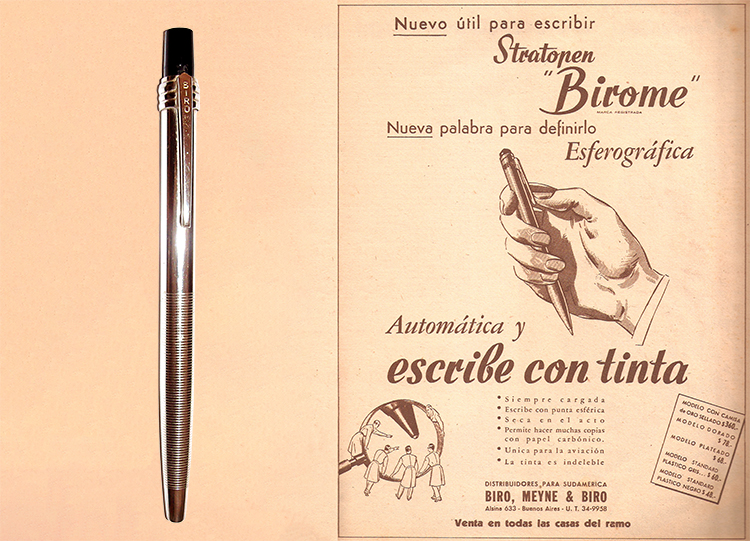
Left: the first Birome ballpoint pen, produced in Argentina (owned by the Fiadone family). Right: Birome advertisement in the Argentine magazine Leoplán, 1945 | wikipedia.org / wikipedia.org
Mass Production: From “Biro” to Bic
After the war, Bíró’s invention quickly turned into a global commercial success. In 1945, László Bíró sold his patent rights to French entrepreneur Baron Marcel Bich. Marcel Bich refined the design to reduce manufacturing costs — for example, he developed equipment for mass-producing miniature metal balls with perfect shape and found an optimal ink formula that wouldn’t dry out in the barrel, wouldn’t leak, and wouldn’t clog the tip.
By December 1950, the company Bich (the name Bic came later, when the “h” was dropped from the surname for simplicity) released its first disposable ballpoint pen, the Bic Cristal. This simple plastic pen with a hexagonal barrel quickly conquered the market thanks to its reliability and low price.
The “Bic Cristal” wrote instantly and without interruption, didn’t need refilling, and was cheap enough to be used without worry — if it broke or ran out of ink, you simply grabbed a new one. Unsurprisingly, by the mid-1950s, ballpoint pens had completely replaced fountain pens in everyday life.
Today, the ballpoint pen has become one of the most mass-produced items on the planet. The company Bic remains a global leader, having sold over 100 billion pens. It is estimated that around 15 million ballpoint pens are purchased worldwide every day.
The Bic Cristal brand was included in the design collection of the Museum of Modern Art in New York as a classic icon — this transparent pen with a simple cap became a truly iconic object.
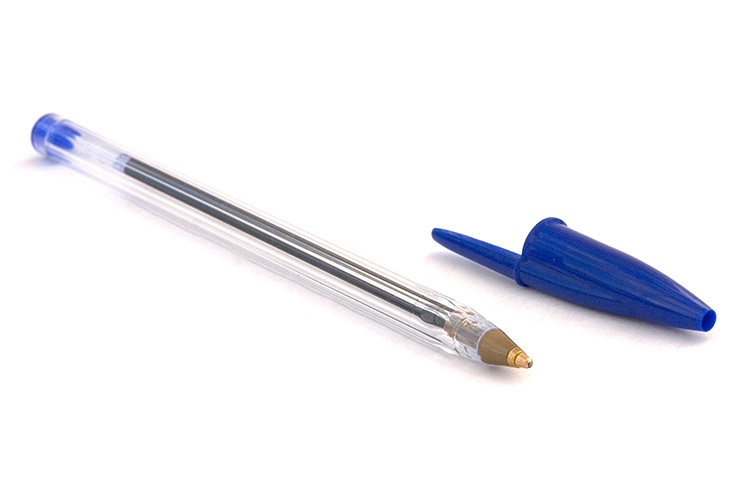
Classic Bic Cristal ballpoint pen | wikimedia.org
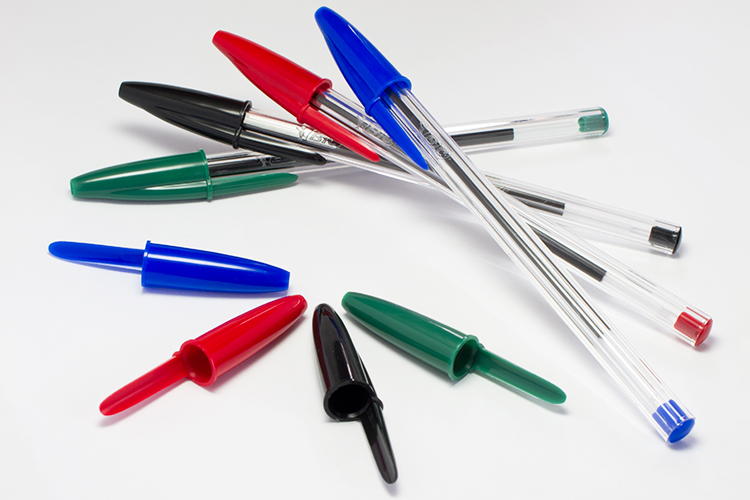
Bic Cristal ballpoint pens with four basic ink colors | wikipedia.org
Legacy and Interesting Facts
Thanks to László Bíró’s invention, the ballpoint pen became an everyday writing tool worldwide. In many countries, the word “biro” became a generic term — used to refer to any ballpoint pen, especially in the UK, Australia, and other former British Empire nations.
In Argentina, the word “birome” still refers to a regular pen — in honor of those very first Bíró & Meyne pens. The inventor himself has not been forgotten either: since 1986, Inventor’s Day has been celebrated in Argentina every year on September 29, László Bíró’s birthday.
Over the decades, the ballpoint pen design has been refined and perfected. The modern writing tip contains a ball made of tungsten carbide — a material so hard that its surface barely wears down over time. The ball’s diameter is typically less than one millimeter, and it is polished for dozens of hours between steel plates to achieve an almost perfect spherical shape.
The pen barrel includes a tiny hole to equalize air pressure — this prevents vacuum buildup during writing and ensures a steady flow of ink to the rotating ball.
Fun Fact
A single ink cartridge can draw lines several kilometers long: for example, calculations show that a Bic Cristal can draw a line up to 2 km long before running out of ink.
Engineers continue to find uses for the ballpoint mechanism in the most unexpected conditions. Special models with sealed pressurized ink cartridges can write in zero gravity, underwater, and in extreme temperatures — from freezing –35 °C to scorching +120 °C. Originally developed for space missions, these pens have proven effective where regular pens fail.
Meanwhile, the simple disposable pen remains an essential companion for modern people on Earth. The rise of electronic gadgets hasn’t displaced it — it’s still hard to imagine a school, office, or home without a ballpoint pen nearby.
This invention is rightly considered one of the most successful in history. As László Bíró’s daughter recalled, her father once heard criticism that ballpoint pens ruined handwriting and calmly replied: “Writing comes from the heart. If our pen helps the hand write more easily — what’s wrong with that?”
The modern ballpoint pen was invented by László Bíró, but its success is the result of the work and smart decisions of many people. From John Loud’s original idea of using a ball instead of a nib, through Bíró’s clever use of fast-drying ink, to Marcel Bich’s entrepreneurial vision that made the pen affordable and widely available — the ballpoint pen has come a long way.
Today, it remains a simple, reliable, and universal tool whose history clearly shows how an invention can transform everyday life on a global scale.