Українська
  Русский
  Polski
  Deutsch
  Français
  Español
  Nederlands
  Svenska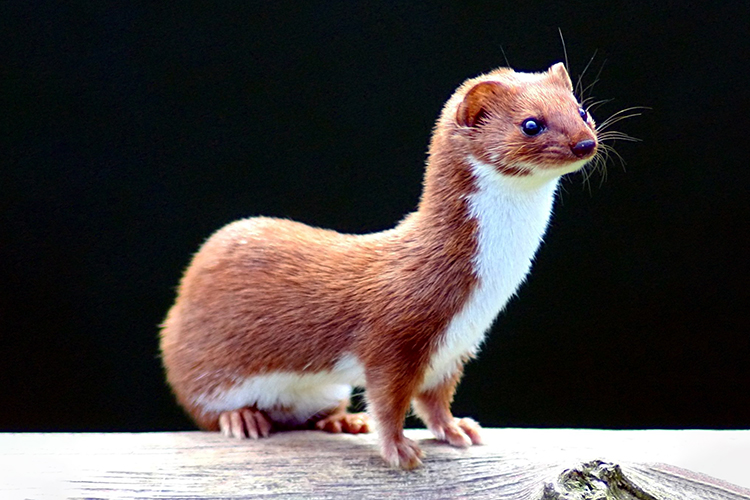
The weasel is the smallest predator on the planet—but don’t let its size fool you. This tiny creature, weighing less than an apple, can kill prey ten times its own size and must hunt almost around the clock to avoid starvation.
In this article, we will examine popular myths about the weasel and present verified facts based on scientific data and observations.
The Stablehouse “Domovoy” Legend
One curious folk belief is associated with the weasel. In old times, peasants believed that their horses were tormented at night by a domovoy — a mythical household spirit in Slavic folklore. It was said that the domovoy would play with the horses at night, braiding their manes, tickling them, and chasing them until exhaustion, so by morning the animals stood covered in foam.
To protect the horses from evil spirits, villagers kept goats in the stables—it was believed that their smell repelled demons. But that didn’t help. The horses kept getting restless at night.
The explanation turned out to be simple: the culprit was the weasel! This nimble animal sneaked into the stable and ran along the horses’ backs and necks. Terrified, the animals tried to shake off the uninvited guest, sweating profusely in the process. Thus, the mystery of the stables was solved: no spirits—just the clever nocturnal tricks of a small predator.
Fun Fact
When a weasel runs across a horse’s neck, the frightened animal struggles violently to shake it off and starts sweating heavily. The weasel then licks the salty sweat—this is how it replenishes its supply of essential mineral salts.
Lone Wanderers or Neighbors?
For a long time, scientists believed that weasels led strictly solitary lives. Since these predators depend so heavily on rodents and consume large quantities of them, it was assumed that they must compete with each other and avoid close contact.
In reality, things are a bit more complex. Yes, weasels do live alone, each within its own territory. But contact between individuals still occurs—this is necessary for the survival of any species. Males and females meet not only for mating; sometimes conflicts happen as well.
When two unfamiliar weasels meet, they may behave aggressively: biting each other’s necks, kicking with short legs, and rolling around while squealing. Such fights are often observed by researchers in laboratories. In the wild, they probably happen less frequently—neighboring animals usually recognize one another and try to avoid confrontation.

Where Weasels Live
Weasels inhabit the entire Northern Hemisphere—in Europe, North Asia, and North America. They can be found from the snowy tundra to the warm Mediterranean forests.
These animals are remarkably adaptable. They settle in fields and forests, mountains and plains, and do not shy away from human dwellings.
A weasel’s home can be under a rock, inside a tree hollow, among the ruins of old buildings, in rodent burrows, barns, or haystacks. To raise her young, the female builds a nest lined with dry grass, moss, and leaves.
Fun Fact
In harsh regions, a weasel may use the snow tunnels made by mice: it moves under the snow, hunting directly in their passages while staying invisible to predators.
Portrait of a Tiny Predator
The weasel rightly holds the title of the smallest predator in the world. Males reach a maximum length of 25 centimeters and weigh no more than 250 grams—about the same as a glass of water. Females are even smaller—almost half that size.
The weasel’s body is long and flexible, with short legs armed with sharp claws. It moves in jumps of 25–30 centimeters. This body structure allows it to enter rodent burrows, squeezing through very small openings.
Fun Fact
In English folklore, people said: “Weasel could slip through a wedding ring.” Of course, that’s an exaggeration, but the animal’s agility is truly impressive—it can squeeze through a hole only 2.5 centimeters wide.
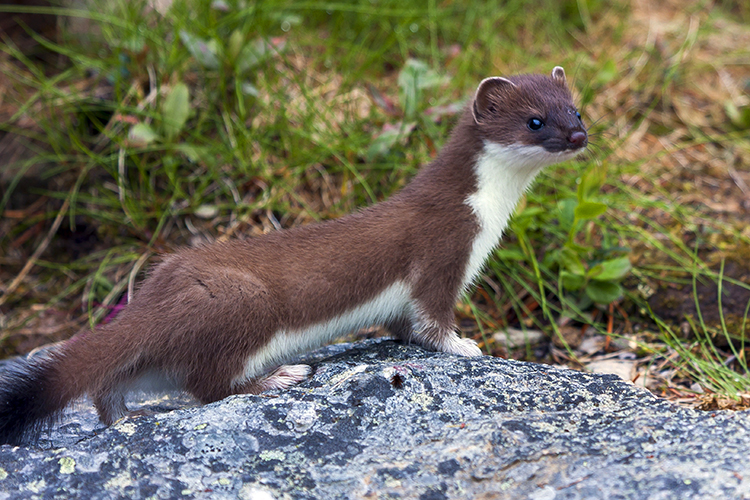
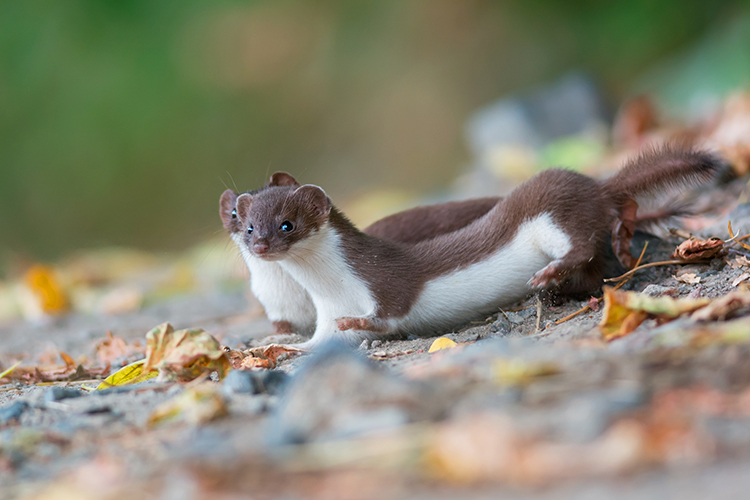
A weasel molts twice a year—spring and autumn. In summer, it wears a brown “coat”: the top of the head, back, sides, tail, and outer legs are brownish, while the throat, upper lip edge, chest, belly, and inner legs are pure white.
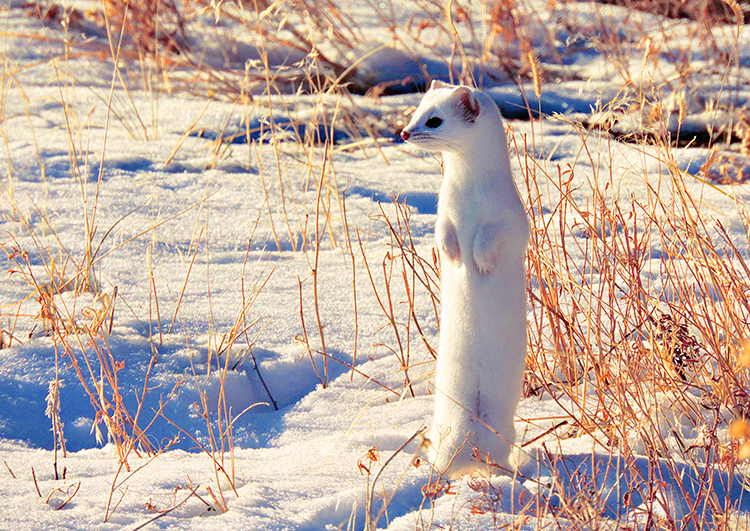
In autumn, an amazing transformation takes place. In northern regions, the weasel changes its brown summer coat for a snow-white winter fur—a perfect camouflage in the snow! In southern areas, where snow is scarce or absent, weasels stay brown year-round.
Fun Fact
The fur color depends not on temperature but on the length of daylight: the shorter the day, the more melatonin is produced, triggering the white molt.
The weasel’s winter coat is denser and softer than its summer one. The hairs become slightly longer, giving the fur a thicker and warmer appearance.
Recently, scientists made an interesting discovery: they found that the change of coat color is controlled by a single gene. A change in just one “letter” of the genetic code determines whether a weasel turns white in winter or stays brown.
Life on the Edge
In the wild, weasels can live up to 7–8 years, but in practice, most don’t survive even two. Their high mortality rate is due to numerous predators—from owls and hawks to foxes and martens.
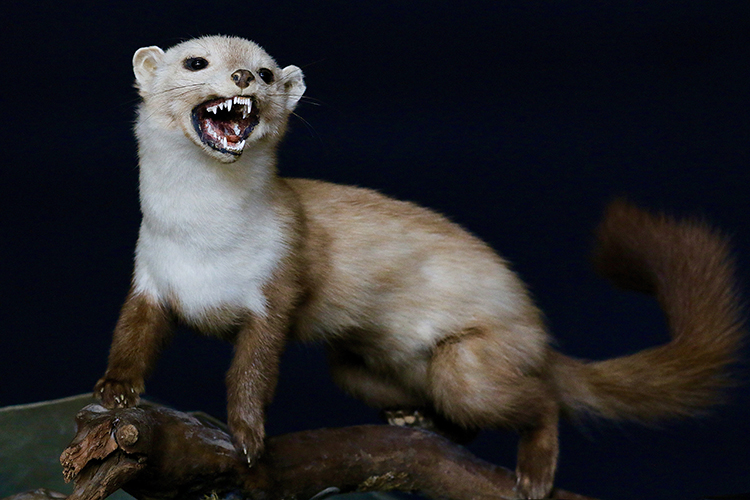
A weasel is usually quiet and makes sounds only occasionally. During play, courtship, or when a mother calls her young, she produces a high trilling coo. When annoyed or threatened, she hisses, and when defending her nest, she emits a loud chirping sound.
These animals are incredibly agile and quick. They run fast, climb well, and swim skillfully. But their main trait is their astonishing courage and aggressiveness, which make them a formidable enemy for all small creatures.
Fun Fact
The weasel has one unusual trait—it cannot stop. Its hunting instinct can’t be “switched off,” even when it’s full.
Ever-Hungry Predator
The reason for its constant hunting lies in its accelerated metabolism. Because of its small size and long, slender body, the weasel loses heat very quickly. To avoid freezing or starving, it must eat more than one-third of its body weight every day. That means 5–10 meals a day!
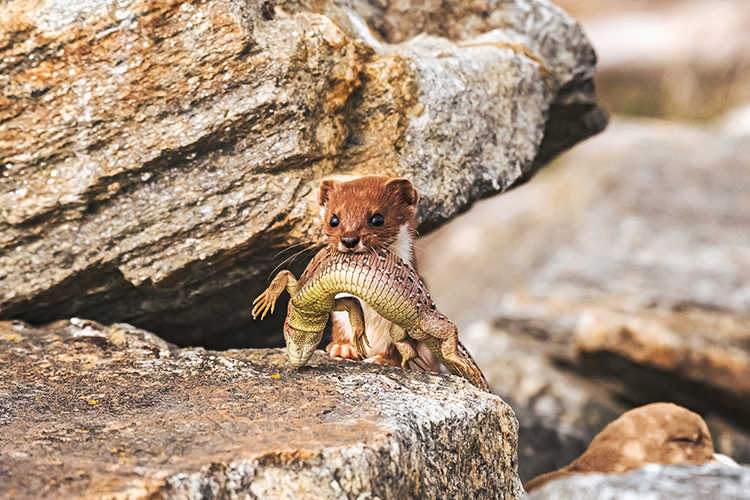
The weasel’s menu is diverse: house, field, and forest mice; shrews; voles; rats; young rabbits; chicks; pigeons and other small birds; lizards; snakes; frogs; and insects. Mice and voles form the basis of its diet—in some areas, they make up to 70% of all prey.
Despite its tiny size, a weasel can kill a rabbit 5–10 times heavier than itself. That’s roughly like a human taking down a bear bare-handed! Young rabbits become an especially important food source in spring when small rodents are scarce. Interestingly, when prey is abundant, the weasel kills more than it can eat, creating caches of food.
Fun Fact
In record cases, zoologists have found over 50 dead rodents neatly piled up by a single weasel.
This behavior is known as “surplus killing.” For a long time, it was believed that the weasel simply couldn’t control its instincts. However, recent studies suggest it might actually be a deliberate survival strategy for winter, when hunting becomes more difficult.
Helper or Pest?
In areas where the weasel is not persecuted, it hunts both day and night. By destroying mice and rats, it provides great benefits. A single animal can control the rodent population over several hectares—a valuable service to agriculture.
Fun Fact
Scientists have calculated that, under favorable conditions, one weasel can destroy up to 3,000 rodents per year. In fields and granaries, this makes it one of the most useful natural “sanitizers.”
But there is another side. Poultry owners know the problem well: a weasel can raid henhouses, mercilessly killing their inhabitants. This “cute” predator usually dispatches its victims with a bite to the back of the head or neck, but sometimes attacks so fiercely that it literally tears the prey apart. Sharp teeth allow it to easily handle a chicken or even a small goose. After a weasel’s visit, several dozen dead hens and chicks may be found in the coop.
Interestingly, the weasel can sometimes fend off relatively large birds of prey, such as kites. Its courage and aggression compensate for its small size.
Weasel and Humans: A History of Relations
There is a common misconception that in Ancient Rome and medieval Europe, the weasel was a domestic animal that hunted mice like cats do. In fact, that is not true.
The confusion arose because, in different languages, the word “weasel” referred to various members of the mustelid family. The actual domestic animal was the ferret—a domesticated relative of the weasel, but a different species. It was ferrets that helped humans fight rodents.
True weasels (Mustela nivalis) have never been domesticated because of their independent and aggressive nature. They do not tolerate captivity well, tend to bite, have short lifespans, and are highly territorial.
When the gray rat appeared in Europe—a larger and more dangerous species than common mice—only cats and ferrets could deal with it. The weasel was simply too small for such an opponent.
Under Threat from Climate Change
Despite their wide distribution, weasels are now facing new threats. The most serious of them is climate change.
Remember the winter color change? In northern regions, the white coat provides perfect camouflage in the snow. But what happens when the snow melts earlier and earlier each year? A white weasel on dark ground becomes an easy target for predators such as foxes, owls, and hawks.
Scientists have found that over the past 50 years, the duration of snow cover in some regions has almost halved— from 80 to 40 days. White weasels are left unprotected for increasingly longer periods.
Evolution cannot keep pace with the climate. Transitioning from the white form to the brown one requires genetic changes—a slow process. As a result, in some regions, white weasels may disappear within the coming decades.
Paradoxically, in many countries, the weasel is still considered a common species not requiring protection. However, monitoring their numbers is extremely difficult—these creatures are so secretive and cautious that even camera traps rarely capture them. Populations may already be declining, but we simply do not notice it.
Remarkable Yet Unseen
The weasel is one of the most remarkable predators on the planet. About the size of a large mouse, it hunts prey larger than itself, must eat almost constantly to survive, can squeeze through incredibly narrow gaps, and displays courage far beyond its size.
This tiny animal plays an important role in nature by controlling rodent populations. For farmers and gardeners, the weasel is a valuable ally in pest control, though poultry owners must take precautions.
Today, weasels face new challenges: habitat loss, climate change, and the growing fragmentation of natural areas. Although they are still widespread, attention to their fate is essential—because the disappearance of even the smallest predator can have unexpected consequences for the entire ecosystem.
Next time you walk through a field or forest, remember: somewhere nearby, a tiny hunter no bigger than your hand is waging its tireless battle for survival—embodying the fascinating blend of fragility and strength created by nature.