Українська
  Русский
  Polski
  Deutsch
  Français
  Español
  Nederlands
  Svenska
In today’s world, parenting often feels like a competitive sport. Social media and ads for “developmental” tools promote the same idea: “the earlier, the better.” If your neighbor’s three-year-old is already reading signs while yours is happily digging in the sandbox, it’s easy to feel a twinge of anxiety. The early development industry promises to raise geniuses by selling flashcards and techniques for infants.
However, a large-scale study combining data from neuropsychology, ophthalmology, and education suggests we should pause and take a breath. Science confirms: reading is not a mechanical skill, but an extremely complex psychophysiological process. Trying to race ahead of nature can cost a child not only their vision but also their psychological well-being.
Let’s explore how the brain actually learns, why “later” often means “better,” and how to help your child love books without turning childhood into a race.
Brain Architecture: You Can’t Build a House Starting With the Roof
Imagine building a house. You can’t put up walls until the foundation is poured, and you can’t install the roof until the walls are up. The child’s brain develops the same way. Neuropsychologists identify three stages (three functional blocks) that mature in strict sequence. Trying to “skip ahead” disrupts nature’s program.
1. The Foundation: Energy and Tone (From 0 to 3 Years)
In the early years, the first functional block develops — the brain’s energy “battery.” This level is responsible for immunity, sleep, emotions, and overall physical health.
Risk of an Early Start: If a child is overloaded with intellectual tasks (like reading) at this stage, the brain is forced to “steal” energy from physical growth. This phenomenon is known as “energy theft”: the child may become irritable, hyperactive, or, on the contrary, lethargic and sickly.
2. The Walls: Perception of the World (From 3 to 8 Years)
During this period, the second block actively develops, processing information from the senses — vision, hearing, and touch. A critical aspect here is the development of spatial orientation (understanding left, right, up, and down).
Why This Matters for Reading: Reading is a directional process (left to right in most languages). If a child’s brain hasn’t yet “calibrated” spatial awareness, letters may appear to “dance” or mirror each other (confusing b and d, p and q).
3. The Roof: Control and Willpower (From 7 to 15 Years)
Only around school age do the brain’s frontal lobes — our “internal executive” — begin to function actively. These areas govern self-control, persistence, and rule-following.
Risk of an Early Start: Reading requires tremendous voluntary concentration. Expecting a 4-year-old to read attentively and deliberately is like asking them to lift a barbell their “mental muscles” aren’t yet ready for.
Unexpected Risks: Genetics and the “Reading Gene”
One of the strongest arguments against accelerated learning comes from genetics and ophthalmology. For a long time, it was believed that poor vision resulted simply from eye strain when focusing on close objects. But modern data paints a more complex picture.
Light and Dopamine Factor
A child’s eyes need bright daylight to grow properly. Sunlight stimulates dopamine production in the retina, which prevents the eyeball from elongating abnormally — the main cause of myopia. Early learning is often dangerous because it displaces outdoor time. Instead of being in the sun, the child sits indoors with a primer.
Genetic Trap (APLP2 Gene)
Scientists have identified the APLP2 gene. Research revealed a striking fact: children with a certain variant of this gene are 5 times more likely to develop myopia — but only if they read intensively in early childhood (more than an hour per day).
If a carrier of this gene leads an active lifestyle and reads little before school age, their vision usually remains normal. This is a textbook example of how environment can “activate” or “silence” a disease.
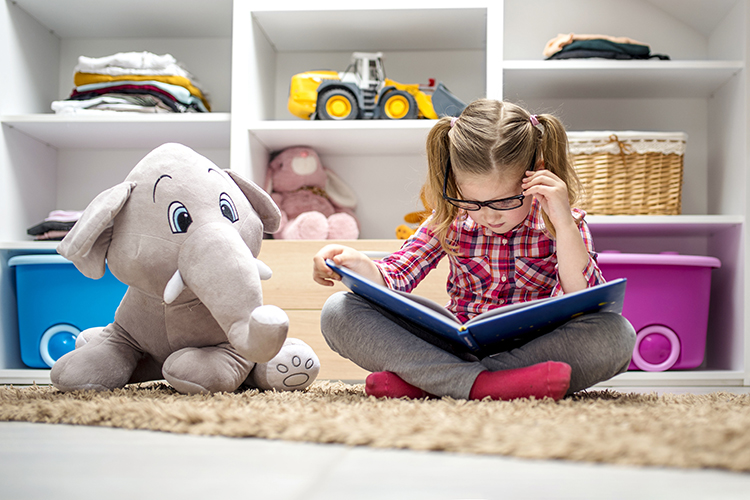
Psychological Cost: The Fade-Out Effect
Advocates of early development often claim that an early start guarantees academic success in the future. Statistics say otherwise. There is a phenomenon known as the Fade-Out Effect.
Children taught to read at ages 4–5 through intensive training may indeed perform better in first grade. However, by third or fourth grade, this advantage completely disappears. Moreover, such children often start falling behind their peers.
The Reason: Early pressure kills natural curiosity. Learning becomes associated with stress, boredom, and performance expectations rather than the joy of discovery. Psychologists call this the “Hurried Child Syndrome” — a state of chronic anxiety caused by adults’ excessive expectations.
Checklist: Is Your Child Ready?
How do you know the time has come? Don’t focus on calendar age — look for physiological readiness markers:
- Developed Speech: The child speaks in full sentences rather than isolated words and can tell a short, coherent story.
- Phonemic Awareness: This is the most important skill. The child should hear and distinguish individual sounds in a word (for example, recognizing that “mom” starts with the [m] sound).
- Spatial Orientation: The child confidently distinguishes left from right, up from down.
- No Speech Therapy Issues: If the child mispronounces sounds or has disrupted speech rhythm, visit a speech therapist before starting to learn to read.

Universal Learning Principles
If your child is ready and shows interest, use methods that support the brain instead of overloading it. These principles apply to any alphabet-based language.
1. Sounds, Not Letter Names
This is the most important rule. In many languages, letter names and the sounds they represent are different.
- Mistake: Teaching alphabet letter names (e.g., “Em,” “Bee,” “Pee,” or “Double-U”).
- Consequence: The child sees the word “MOM” and tries to read it as a string of names: “Em-Oh-Em.” It’s hard for them to blend it into a word.
- The Right Way: Teach sounds. Short and clear: [m], [b], [p], [s]. First explain what sound the letter makes — then teach its name.
2. From Whole to Parts: “Doman Method” vs. Science
Some approaches (e.g., Glenn Doman’s method) suggest showing babies flashcards with whole words for rote memorization. Modern science views this skeptically. It trains memory, but not reading skills.
The child memorizes the word as an image (like a hieroglyph) but won’t be able to read unfamiliar words. Effective reading is based on understanding how sounds combine into syllables and syllables into words.
3. Environment Matters More Than Lessons
Don’t force your child to study. The best way to spark interest is to scatter books around the house and read yourself. Children mimic adults — if they see you reading, they’ll reach for books too.
4. Learning “In Passing”
Learning can happen anywhere: on a walk, in a store, at a café. Read signs, street names, and food labels. This shows your child that reading is not a boring duty, but a vital tool for real life.
5. Learning Through Play and Sensory Activities
Children learn through their hands.
- Mold letters from clay, bake letter-shaped cookies, cut them out of cardboard.
- Use magnetic alphabets on the fridge.
- Ask the child to find a specific letter in a text or highlight all the vowels.
6. The “Bookmark Trick”
Here’s a simple trick for beginner readers. Bookmarks usually cover text below to prevent distraction.
Try the opposite: Use the bookmark to cover what the child has already read (move it left to right with the reading).
Why: It helps the eyes focus on the new word and not “jump back,” which often disrupts rhythm and comprehension.
7. “Reading Journal” and Micro-Goals
To keep motivation up, start a “Reading Journal” where you track progress. Agree on small rewards for every 100 words or books read.
The key is consistency. It’s better to read 10–15 minutes every day than an hour once a week. This prevents fatigue and reinforces the skill faster.
Conclusion: Slow and Steady Wins the Race
The golden rule of learning is love and patience. Never scold your child for mistakes or raise your voice — otherwise, reading will forever be associated with fear.
Remember: every child develops at their own pace. Your job is to create the right conditions and nurture interest — not break records. Healthy vision, strong nerves, and a love of learning matter far more than reading at age three.