Українська
  Русский
  Polski
  Deutsch
  Français
  Español
  Nederlands
  Svenska
Every child needs love, care, and physical affection from birth — regardless of gender. However, in many cultures, a stereotype still persists: girls need tenderness, while boys should be raised with strictness and without “babying.”
Many parents, often unconsciously, treat their sons more reservedly, hug them less often, and express fewer emotions. But are boys truly less sensitive? Modern scientific research suggests otherwise.
Some studies show that during the first year of life, girls are picked up and hugged significantly more often than boys — sometimes five times more or even more. This is not just an interesting statistic: such a gap in physical closeness can impact a child's emotional and physical development. Psychiatrists and neuropsychologists increasingly emphasize that boys also need physical love and attachment, especially in the early years when their basic understanding of themselves and the world is being formed.
Why Physical Affection Matters for Boys from Birth
From the very first days, physical contact with parents is one of the most important forms of communication and a key source of safety for a child. It helps regulate physiological processes such as breathing, heart rate, and sleep. But it is equally vital for brain development.
Physical affection is not just about tactile pleasure. Hugs, kisses, and gentle touches stimulate the release of oxytocin — the hormone responsible for bonding and emotional closeness. Regular physical contact activates brain areas related to trust, calmness, and the ability to empathize.
Neuropsychologist Allan Schore, a specialist in emotional attachment, and other researchers note that boys are biologically slightly more vulnerable in the first months of life. Their nervous systems develop more slowly, and they handle stress less effectively. This means boys especially need physical reassurance — it signals that the world is safe and a reliable adult is nearby.
Renowned American psychiatrist Ross Campbell, in his book “How to Really Love Your Child,” emphasized that a lack of physical affection from birth to around age 7–8 may contribute to increased anxiety, behavioral issues, and difficulties in social interaction. He pointed out that boys under the age of three are significantly overrepresented in psychiatric clinics in the U.S. compared to girls — a disparity that becomes even more pronounced in adolescence. This imbalance is not coincidental: it indicates that boys are missing emotional support and physical affection.
What Happens When Affection Is Lacking
When a child, especially at a young age, does not receive enough physical contact and emotional warmth, their body remains in a constant state of stress readiness. This affects behavior and the development of the immune, nervous, and cardiovascular systems.
Lack of affection can lead to:
- Increased anxiety and irritability
- Reduced ability to empathize and form close relationships
- Low self-esteem
- Tendency toward impulsive or aggressive behavior
- Sleep disturbances, trouble focusing, and difficulties adapting in group settings
Research in psychosomatics shows that adults who grew up in emotionally cold environments are more likely to suffer from chronic health issues — particularly hypertension, cardiovascular disorders, eating disorders, and depression.
Psychologists François Lespérance and Nancy Frasure-Smith emphasized that parenting style in childhood shapes not only mental health but also overall physical well-being in adulthood. Children raised in strictly controlled environments without open dialogue or freedom to express emotions are more likely to develop what is known as a repressed personality type, which is prone to chronic stress and psychosomatic illnesses.
How the Need for Closeness Changes With Age
An infant needs to be hugged, rocked, and held close. At this age, every gesture of love is a signal of safety. As children grow, the forms of physical closeness may change, but its importance remains.
During the preschool years (ages 3–6), boys actively explore the world and may seem less dependent on physical affection — yet it remains essential. This is a time of play, laughter, and shared activities. Physical contact in the form of hugs, warm touches, and active play strengthens the emotional bond between parent and child.
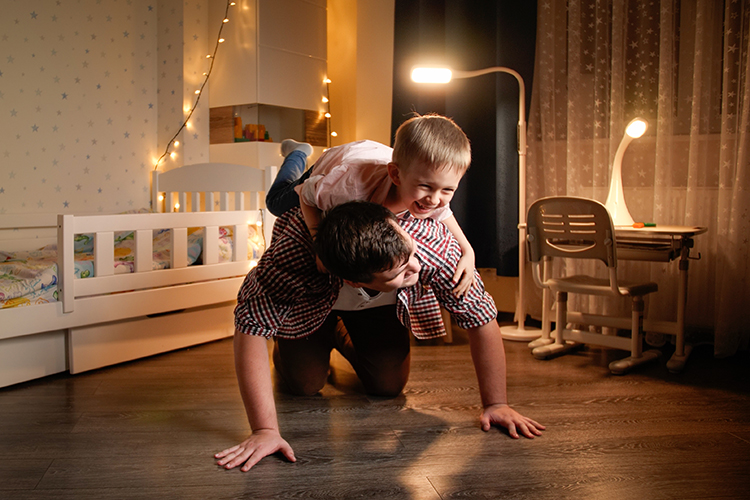
As boys get older, traditional forms of tenderness often fade into the background. In their place come more “masculine” interactions: wrestling, roughhousing, pats on the back, and playful teasing. This is more than just play — it is a form of approval, support, and connection. Through it, a father can show his son that he is present and accepting.
In early school age (ages 7–11), many boys begin to shy away from open displays of affection, especially in public. This is often influenced by social norms and a growing desire for independence. However, at this age, physical contact can be transformed: a pat on the shoulder, a handshake, or play wrestling — all remain expressions of love and support.
Teenagers (12 and up) often reject hugs and kisses. But during times of stress — illness, disappointment, conflict — the need for parental support returns. Even if a son appears distant, it’s important to stay close, respect his space, and keep the door open to physical and emotional connection.
It is essential that parents do not reject a teenager’s attempts to reconnect. If a boy comes home after a hard day and wants to hug his mother or sit next to his father, it is important not to push him away with phrases like “you’re too old for that.” These gestures are signs of trust and a deep inner need for acceptance.

Authority or Harshness: How Parenting Style Affects Health
Some parents believe that strictness and emotional distance build character. However, numerous studies refute this. Harsh parenting without affection — where a child’s emotions are ignored — tends to produce an outwardly obedient but inwardly anxious child.
Psychologists identify several parenting styles:
- Authoritarian — strict control with minimal warmth. Often leads to emotional suppression, low self-esteem, and chronic stress.
- Permissive — excessive freedom with no boundaries. The child lacks structure and a sense of security.
- Authoritative — a balance of clear boundaries with warmth and attention. Recognized as the most beneficial style for raising a healthy, confident individual.
A parent who can express love while setting reasonable boundaries helps the child learn self-regulation and fosters a sense of safety and stability.
Practical Tips: How to Show Love to a Boy
Ages 0–2:
- Hold, hug, and rock your child often
- Respond to crying with calm attention
- Use skin-to-skin contact — it strengthens emotional bonding
Ages 3–6:
- Engage in active play together
- Hug before bedtime and after waking up
- Respect emotional expression; don’t shame them for tears
Ages 7–12:
- Replace hugs with friendly gestures (handshakes, pats on the back)
- Create family rituals: a handshake, a secret greeting sign
- Spend quality time together: sports, board games, walks
Teenagers:
- Don’t impose, but make it clear that you’re present and open to conversation
- Respect their personal space, but remain emotionally available
- Offer support gently and respectfully during difficult times
In Conclusion
Boys are just as sensitive as girls. They need tenderness, attention, and emotional support. Physical closeness is not a weakness — it is a vital tool for building confidence, empathy, and psychological resilience.
Raising a boy with warmth and reasonable boundaries helps him grow into not only a physically healthy but also emotionally mature individual. Tenderness is not a luxury — it is a fundamental need that cannot be replaced. It is precisely what makes boys strong from within.