Українська
  Русский
  Polski
  Deutsch
  Français
  Español
  Nederlands
  Svenska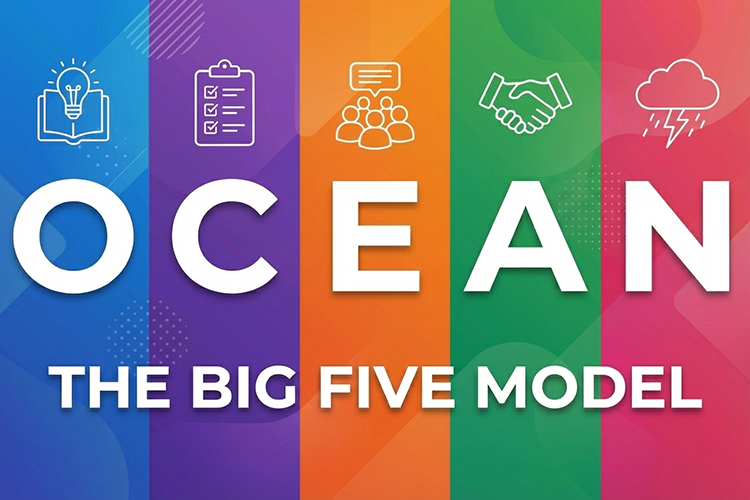
© Factum-Info
Imagine you are trying to describe an old friend to someone who has never met them. Where would you start? Would you say they are the life of the party? Or that they can always be relied on but tend to worry about the little things?
For centuries, psychology has tried to find a universal code that would describe any person. Eventually, scientists discovered the “Big Five”—the modern gold standard that allows personality to be broken down into components with scientific precision.
Discover your personality profile with our Big Five (OCEAN) test
How Language Suggested the Answer: The Lexical Hypothesis
The most amazing thing about the “Big Five” is that it was not invented in offices. It was discovered within human language itself. This approach, known as the lexical hypothesis, asserts: all socially significant differences between people are encoded in speech. If a trait was important for survival or social interaction, people inevitably created a word for it in the course of evolution.
The history of this discovery resembles massive data archaeology. Back in 1884, Sir Francis Galton, a prominent English polymath and anthropologist of the Victorian era, was the first to suggest that the frequency of words describing character is directly proportional to the importance of these traits for society.
Later, in 1936, psychologists Gordon Allport and Henry Odbert analyzed Webster’s Dictionary and extracted 17,953 words describing personality. With the advent of computer technology, scientists were able to “compress” this colossal list. No matter which language or culture they turned to, the data invariably grouped around five independent axes.
Five Facets of Personality: A Deep Dive
Unlike popular typologies that divide the world into “black and white,” the “Big Five” views personality as a system of five independent factors. These are not rigid categories but continuous spectra.
Each person is situated at a specific point on the five OCEAN scales. Imagine each trait as a slider on a mixing console: it is not simply turned on or off but set to a certain level—higher or lower. It is the combination of these settings that determines our habitual behavior, reactions to stress, way of communicating with loved ones, and much more.
O — Openness to Experience
This is an indicator of how curious you are and how ready you are to welcome something new into your life—from unusual food to innovative ideas.
- “Hungry Mind” and Creativity: People with a high score constantly seek new knowledge and impressions. Their brain works like a filter that lets through many more details than others. This is what allows them to connect seemingly unrelated things and make creative breakthroughs.
- Ideology and the Power of Traditions: This trait largely determines our views on the world. While high openness pulls a person toward change and the search for novelty, low openness (traditionalism) helps preserve time-tested practices and cultural norms.
C — Conscientiousness
Reflects your ability to exercise self-control, plan tasks, and not quit halfway.
- The Key to Career Success: This is the most reliable predictor of how far a person will advance in their career. It is simple: such people do not approach tasks carelessly; they are hardworking and results-oriented. It is their reliability that eventually translates into rapid career growth and a high salary.
- Recipe for Longevity: Disciplined people live longer. It is not just about healthy habits—like sports or proper nutrition. The very biology of their body works differently: thanks to the ability to cope with stress, they suffer less from internal inflammatory processes, which protects the heart and strengthens the immune system.
E — Extraversion
Many consider this simply “sociability,” but in reality, it is a way of recharging the internal “battery” and a reaction to external stimuli.
- Drive and Energy Seeking: Extroverts draw strength from social interaction, exciting events, and achievements. Their brain reacts more keenly to potential rewards—recognition, status, or new experiences. For them, activity and interaction with the world are ways to get a powerful boost of energy and feel their best.
- Silence as Recovery: Being an introvert does not mean being shy. It means having high sensitivity to the “noise” of the outside world. An introvert’s brain already constantly operates at high intensity, so excess commotion quickly drains their strength. Such people vitally need a calm environment and solitude to restore their energy.
A — Agreeableness
This indicator reveals how much of a team player you are and how strongly you strive for peace and harmony with others.
- The “Peacemaker” in the Team: People with a high score are real social glue. They know how to smooth out rough edges, trust colleagues, and create an atmosphere around them where everyone is comfortable working. Without such people, any team would quickly get bogged down in conflicts.
- The Price of Excessive Kindness: However, a soft character has a downside. Statistics show that less agreeable people (especially men) often earn more than their “nicer” colleagues. It all comes down to negotiations: those who care less about being liked by everyone assert their interests more firmly and negotiate better terms for themselves.
N — Neuroticism
This is your internal “security system” that determines how acutely you react to stress and potential troubles.
- The “Smoke Detector” Principle: Our brain is wired so that it is better to be scared by an empty bush one extra time than to miss a predator hiding in it. People with high neuroticism constantly “scan” the world for threats. This is not a mental defect but a mode of maximum vigilance that helped our ancestors survive.
- The “Healthy Neurotic”: Sometimes anxiety can even be useful if it is combined with high discipline. Such a person does not just worry about health but immediately goes to the doctor and gets tested on time. As a result, their vigilance helps them live longer and eliminate any dangers in a timely manner.
How Do These Factors Work Together?
In modern science, there is the Cybernetic Theory, authored by Colin DeYoung—an American psychology professor at the University of Minnesota and one of the world’s leading researchers of the “Big Five.” This theory views our personality not just as a set of habits but as a complex goal-management system. According to it, the five OCEAN factors combine into two powerful meta-factors:
- Stability—your “anchor,” consisting of Conscientiousness, Agreeableness, and low Neuroticism. It helps you maintain order in life and protect your goals from chaos and conflicts.
- Plasticity—your “engine,” uniting Extraversion and Openness. It is responsible for your growth, the search for the new, and flexible adaptation to changes.
Summing Up: How OCEAN Changes Life
The “Big Five” is not just a list of qualities but a detailed map of your character. It does not divide people into “right” and “wrong” but shows where your unique strength lies and where your weak points may be hiding.
By understanding your Big Five (OCEAN) profile, you will be able not just to go with the flow but to consciously choose a career and environment that suit you perfectly.