Українська
  Русский
  Polski
  Deutsch
  Français
  Español
  Nederlands
  Svenska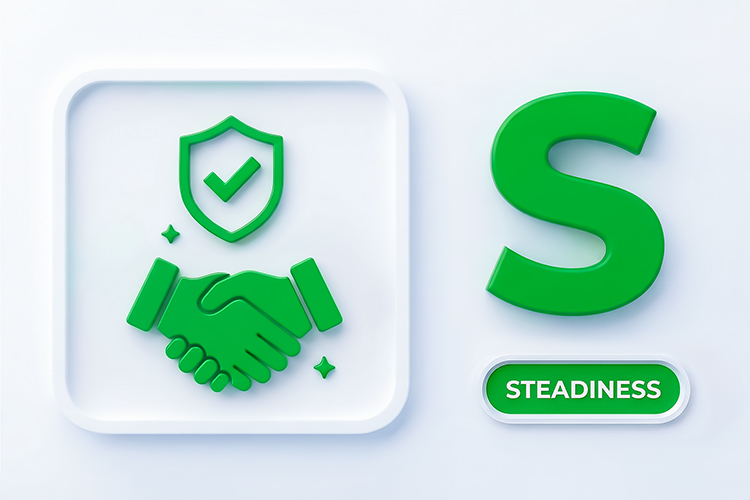
© Factum-Info
In a world obsessed with speed and leadership, this type often remains unfairly in the shadows. While “Reds” (D) conquer markets and “Yellows” (I) deliver presentations, the “Greens” — Type S (Steadiness) — are the ones who keep it all running and prevent it from falling apart.
In the classic DISC typology, they’re known as the “glue” that holds the team together. They are the primary keepers of peace. But don’t be fooled by their gentleness. As the creator of the DISC model said, behind their outward agreeableness often lies the most stubborn kind of strength.
Today we’ll explore the psychology of the S type: why they fear change, how to recognize their “quiet rebellion,” and why they possess the highest emotional intelligence in the workplace.
Determine your behavioral style with our DISC Personality Test
Psychological Code: Harmony Above All
To understand Type S, we must recall William Marston’s coordinate axes.
- Perception of Environment: Like the cheerful I types, S types see the world as favorable (friendly).
- Response: However, their response is passive. They prefer to adapt to the world rather than reshape it and focus on cooperation.
Their superpower is patience and consistency. If D is a sprinter, then S is a marathoner who reaches the finish line after everyone else has burned out.
Interesting Fact
In the original 1928 theory, William Marston referred to this factor as Submission. However, it sounded as if the person were weak and spineless. This term didn’t work well for the business world, so it was replaced with Stability.
That was an improvement, but a new issue arose: “Stability” suggested that a person remains static and fears change. But S types are the backbone of any office! That’s why modern psychologists adopted the ideal term — Steadiness (Consistency/Dependability).
How to Identify Type S: Signs of the “Green” Factor
People with high S are rarely seen or heard immediately. They don’t interrupt or seek the spotlight.
- Speaking Style: Soft and calm. They often use “we” instead of “I.” Their speech includes many softening phrases: “Maybe,” “Kind of,” “Would you mind…”
- The No. 1 Listener: These are the people you open up to about your problems. They listen not to respond (like D) or shift the topic to themselves (like I), but to understand and support.
- Body Language: Relaxed posture, minimal abrupt gestures. They create a zone of comfort around them.
- Work Approach: They love instructions, procedures, and predictability. The phrase “This is how we’ve always done it” means reliability to them, not resistance to change.
Cognitive Style: The “Procedural Thinking” Phenomenon
D-type leaders are often frustrated by the “slowness” of S-type employees. But it’s not slowness — it’s depth of processing.
The cognitive style of S is procedural and consistent. They need time to integrate new information into their existing worldview. They can’t just drop everything and run in a new direction. They need to understand: “Is it safe?”, “How will this affect the team?”
But once an S takes on a task, they see it through. They are the psychological foundation of the organization, securing its rear.
They also have exceptional empathy. They sense the emotional atmosphere of the team better than any device and often defuse conflicts before they arise.

Shadow Side: Quiet Sabotage
The biggest mistake is assuming that S agrees just because they’re silent. Their main fears are loss of stability and open conflict.
Since S fears direct confrontation, their disagreement goes underground. Psychologists call this passive resistance.
- If an S disagrees with a new task, they won’t slam the table. They’ll just “forget” to do it, misplace the email, or endlessly ask for clarification.
- S-type stubbornness is legendary. Once a “Green” decides not to budge, it’s harder to move them than to stop a train. For a manager, it’s extremely difficult to detect this rebellion early on.
Combinatory Profiles
A pure S is a “peacemaker.” But more often, we see mixed types. Let’s explore the two most common combinations.
1. “Coordinator” Profile (High S + High C)
These are people with strong loyalty (S) and attention to detail (C). Ideal administrators, accountants, and technical specialists.
Risk: “Analysis paralysis.” In a crisis without clear instructions, they may freeze and wait for directions until the very last moment.
2. “Team Spirit” Profile (High S + High I)
Very warm, people-oriented employees. For them, team atmosphere matters more than KPIs.
Risk: They find it hard to give negative feedback or fire someone. They’ll tolerate a toxic colleague for years just to avoid conflict.
Conflict Zones: When Things Get Difficult
The main enemy of the S type is sudden change.
- Conflict with D (Dominance): It’s a clash of speeds. D pushes and demands things “yesterday,” while S shuts down and slows down to ensure safety. D sees this as stupidity, while S sees D as an aggressor.
- Conflict with Change: If you come to an S and say, “Forget everything we’ve done for the last 5 years — we’re rolling out a new system tomorrow,” you’ve lost that employee. For S, it’s the end of their world.
User Manual: How to Work and Live with Type S
If you want to earn S’s trust, you’ll need to switch your approach from “attack” to “support.”
1. Don’t Apply Pressure
Pressure destroys relationships with S. Don’t demand an answer “right now.”
- Wrong: “I need a decision right now! We don’t have time to think — say yes or no!”
- Right: “Here’s the background info. Take some time to think it over, and let’s discuss it tomorrow morning.”
The second option gives them the processing time they need.
2. Guarantees and Instructions
Security is essential for S types. When selling them an idea or product, emphasize guarantees, proven methods, and support.
A phrase like “We won’t leave you hanging and will support you every step of the way” works better than any discount. On the job, they need clear step-by-step instructions, not abstract goals.
3. Appreciate Their Loyalty
S types are the most loyal employees and partners. They might stay with one company for 20 years. But they need genuine appreciation for their reliability. Don’t take their help for granted. Ask them, “How are you coping with this workload?” To them, this shows they are seen as people, not just as a function.

Interesting Facts About Type S
- Color: Traditionally represented by green. It symbolizes nature, growth, calmness, and safety.
- Most Common Type: Statistically, S traits (pure or mixed) are the most frequently found among the population. This makes evolutionary sense — society needs more caretakers and executors than risk-taking leaders.
- Ancient Roots: In Hippocrates’ system, this type corresponds to the phlegmatic. These are people with stable nervous systems who are hard to provoke.
- Shopping Style: They are the most loyal customers. If an S finds a brand or hairdresser they like, they’ll stick with them for years, even if quality drops slightly. They pay for predictability.
- Famous S Types: Princess Diana, Mother Teresa, Mahatma Gandhi. These are “servant leaders” who led not with force but with care and personal example.
Conclusion
Type S is not about weakness. It’s about the strength of consistency. While others chase the latest trends, S stays the course. They remind us that in the race for success, it’s important not to lose our humanity.
They may be quiet heroes, but remove them from the equation, and any business — no matter how brilliant — will collapse without their support.
We’ve explored fire (D), air (I), and earth (S). One element remains — ice and logic. In the final article of the series, we’ll reveal the secrets of Type C — people who value facts over feelings and rules above all else.