Українська
  Русский
  Polski
  Deutsch
  Français
  Español
  Nederlands
  Svenska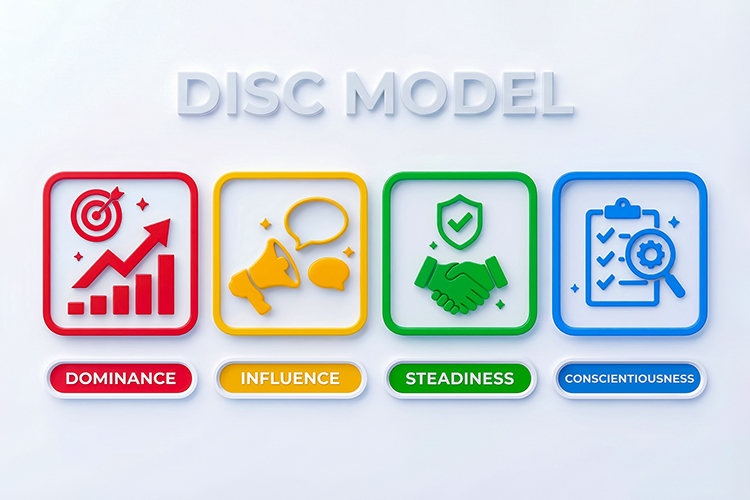
© Factum-Info
Why do we find common ground with some people in just five minutes, while with others we can’t reach an agreement for years? Why does your colleague demand dry numbers, while a client wants to discuss how the weekend went? Why is one employee motivated by a challenge, while another is driven by a sense of security?
We tend to attribute this to a “difficult personality” or “incompatibility.” But in reality, a clear system is hidden behind this apparent chaos.
Meet: The DISC Model (Dominance–Influence–Steadiness–Conscientiousness). This is not just another online test. It is a fundamental tool used by more than 80% of companies from the Fortune Global 500 list.
Today, we will explore how this “map of the human soul” works, who created Wonder Woman, and how this knowledge helps sell, manage, and even preserve families.
Determine Your DISC Personality Type Using Our Test
History: From Hippocrates to Marvel Comics
The DISC system has a remarkable lineage. Its roots go back to Ancient Greece. Hippocrates already observed that people fall into four temperament types (choleric, sanguine, phlegmatic, melancholic). Humanity changed, technologies evolved, but these four basic archetypes remained unchanged for thousands of years.
However, the father of the modern model was Dr. William Marston. In 1928, he published the book Emotions of Normal People, in which he translated ancient knowledge into the language of science.
Interesting Fact
Dr. William Marston was a truly unique figure. By day, he was a serious Harvard psychologist, and in the evening... he created comic books. He was the creator of Wonder Woman. And if you look closely, you can find traits of an ideal DISC leader in her character.
Inner Compass: How Does It Work?
The main mistake beginners make is thinking that DISC simply “puts people into boxes.” In reality, Marston proposed not boxes, but a coordinate system. He realized that our behavior depends on two fundamental questions that our brain answers unconsciously:
-
How Do I See the World?
- Do I see the environment as hostile/antagonistic (full of challenges and obstacles)?
- Or do I see the environment as favorable (friendly and full of opportunities)?
-
How Do I Act?
- Do I act actively (shaping the world to fit me)?
- Or do I act passively (adapting and cooperating)?
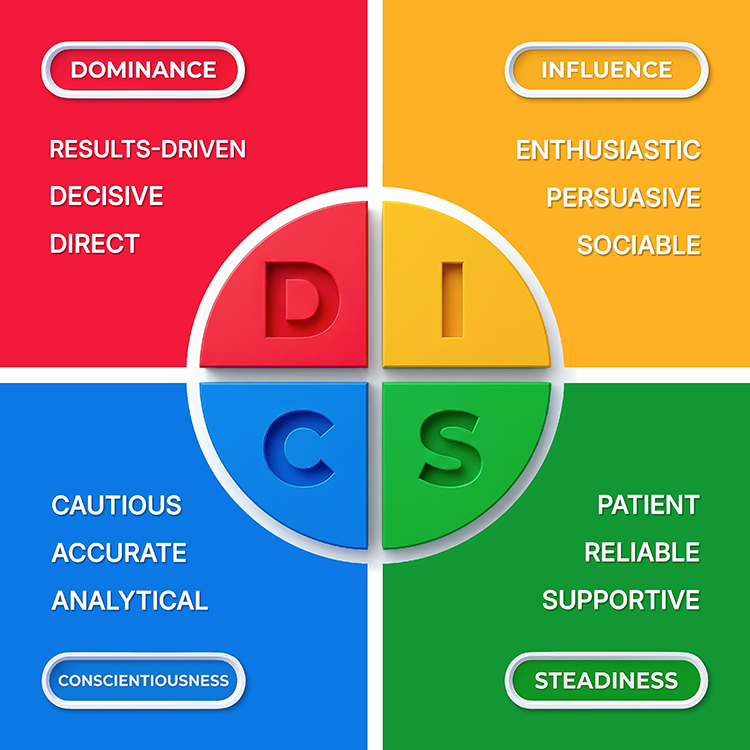
The intersection of these answers gives rise to four behavioral forces.
© Factum-Info
The Four Colors of Humanity
D — Dominance
Leaders, commanders, achievers.
- Formula: Hostile environment + Active action.
- Motto: “I came, I saw, I conquered.”
- Psychological Profile: They see life as a challenge and strive to overcome it. They are result-oriented, speak directly, and act quickly. They often behave authoritatively and like to tell others what to do.
- How to Recognize: Active gestures, fast walking pace, frequent interruptions, statements rather than questions.
- Main Fear: Being used and losing control.
I — Influence
Speakers, inspirers, the life of the party.
- Formula: Favorable environment + Active action.
- Motto: “Together we will move mountains (and have fun doing it).”
- Psychological Profile: Charismatic optimists. They believe the world is kind and win it over not through force, but through charm. They are focused on people, creativity, and communication, and easily jump from one topic to another.
- How to Recognize: Expressive facial expressions, lots of talking, reduced personal distance, creative chaos at the workplace.
- Main Fear: Social rejection and indifference toward their personality.
S — Steadiness
Peacemakers, reliable partners, guardians.
- Formula: Favorable environment + Passive action.
- Motto: “The slower you go, the farther you get.”
- Psychological Profile: The reliable backbone of any team. They value harmony, predictability, and reliability. They are the best listeners and the most loyal employees. They find it difficult to say “no,” which is why they are often overloaded with work.
- How to Recognize: Soft speech, use of the pronoun “We,” moderate gestures, strong listening skills.
- Main Fear: Sudden changes and conflicts.
C — Conscientiousness
Analysts, experts, critics.
- Formula: Hostile environment + Passive action.
- Motto: “Measure seven times, cut once.”
- Psychological Profile: People of systems. They see the world as chaos that must be organized through rules and logic. They are focused on accuracy, facts, and quality. Emotionally reserved.
- How to Recognize: Reserved facial expressions, reliance on numbers and facts, many clarifying questions, taking notes in a notebook.
- Main Fear: Mistakes, criticism, and breaking the rules.
Where It Really Works: Fields of Application
Many consider personality tests a form of entertainment, but DISC is a practical tool with a wide range of applications. Here’s where this model saves money—and nerves.
1. Business and Human Resource Management (HR)
Here, DISC is the de facto standard.
- Ideal Hiring (Job Benchmarking): You can’t just hire a “good person.” You need to understand the job profile. For example, a cold-calling manager should have a high D (drive) and I (communication). If you place a gentle S in that role, they’ll burn out from stress and rejection within a month.
- Employee Onboarding: Each type needs a different approach in the first few days. A D should be given a tough task right away—with no micromanaging. An S needs clear instructions and friendly introductions. A C should be granted access to the knowledge base and internal regulations.
- Team Building: Fill a department with only I (Influence) types, and it will be fun and creative—but a disorganized mess. Fill it with only C (Analysts), and you’ll get perfect order with zero drive. An effective team balances different energies.
2. Sales and Negotiation
This is where the real “magic” of DISC shines. Knowing the client’s type allows you to sell in their language.
- Client D: Sell fast. Talk about results, profit, and status. Use the “Elevator Pitch” strategy. Give them options so they feel in control.
- Client I: Sell emotionally. Tell stories (Storytelling), give compliments, show that “cool” people use this product. Build a friendly relationship.
- Client S: Sell gently. Don’t rush them. Offer safety guarantees, other clients’ reviews, and promise support (“We won’t leave you alone”). Use a consultative selling approach.
- Client C: Sell with expertise. Skip the emotions—provide numbers, charts, comparisons, and technical specs. Expect skepticism and counter with facts.
3. Personal Effectiveness and Relationships
DISC helps far beyond the office walls.
- Self-Awareness: Knowing your type helps you stop fighting yourself. If you’re an S, you don’t need to become a tough D commander. Your strength lies in empathy and reliability. Focus on developing those.
- Family: How many arguments arise when the analytical husband (C) demands order and punctuality from his spontaneous wife (I), while she expects emotions and surprises from him? Understanding your partner’s nature eliminates blame: he’s not “boring”—that’s just how he sees the world.
© Factum-Info
Practical Example: Implementing Change
Imagine a company introducing new software. Here’s how different personality types might respond:
- Type D: “Great! Will this help us work faster and make more money? Let’s do it!”
- Type I: “Awesome! All the modern companies use this. We’ll be so on trend!”
- Type S: “I hope the program isn’t complicated... I just want us to adjust quickly and keep our usual rhythm.”
- Type C: “How much is the license? What’s the return on investment? There’s a risk that productivity might drop by 15% during rollout. We need to calculate everything.”
A manager unfamiliar with DISC will try to “sell” the idea to everyone the same way—and fail. A wise manager tailors the message: showing profit and challenge to the D, prestige to the I, security and support to the S, and facts and projections to the C.
What to Keep in Mind (DISC Isn’t a Magic Bullet)
- It’s not an intelligence test. DISC measures behavior, not mental ability (IQ), education, or emotional intelligence (EQ). People of any type can be geniuses.
- Pure types are rare. We’re all a mix of traits. Most people have one or two dominant colors, but in different situations, they may exhibit different behavioral models.
- There are no bad types. The world needs bold generals, inspiring speakers, caring guardians, and meticulous engineers. Each type has its own superpowers—and weaknesses.
Conclusion
The DISC Model isn’t about labeling people. It’s about learning how to speak their language. Once you understand what drives someone—whether it’s a thirst for victory, connection, peace, or truth—you gain the key to conflict-free communication.
After all, we’re all different—but predictably different. And understanding that predictability makes life and business much simpler and more effective.
Do you feel one of the letters perfectly describes you or your boss? That’s just the tip of the iceberg. We’ve prepared a series of in-depth guides for each personality type. Want to know how to handle a “Red” leader, what a “Yellow” enthusiast secretly dreams of, what the superpower of the “Green” guardian is, and how to connect with the “Blue” perfectionist? Explore the detailed articles below—we’ve covered everything: from core fears to ideal environments for each type.