Українська
  Русский
  Polski
  Deutsch
  Français
  Español
  Nederlands
  Svenska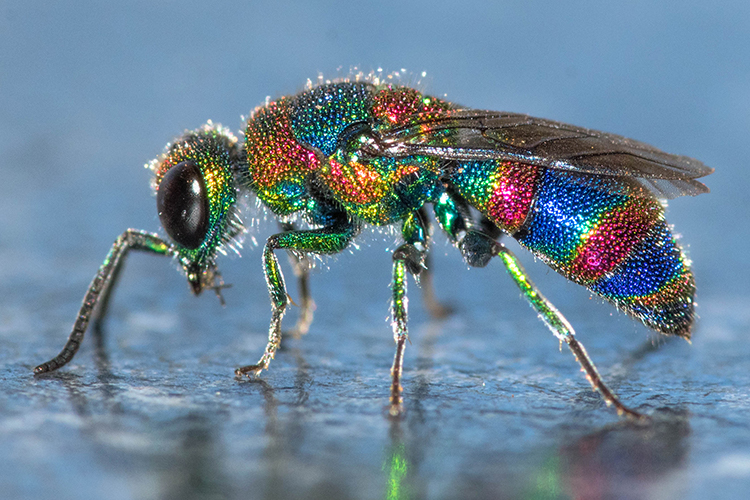
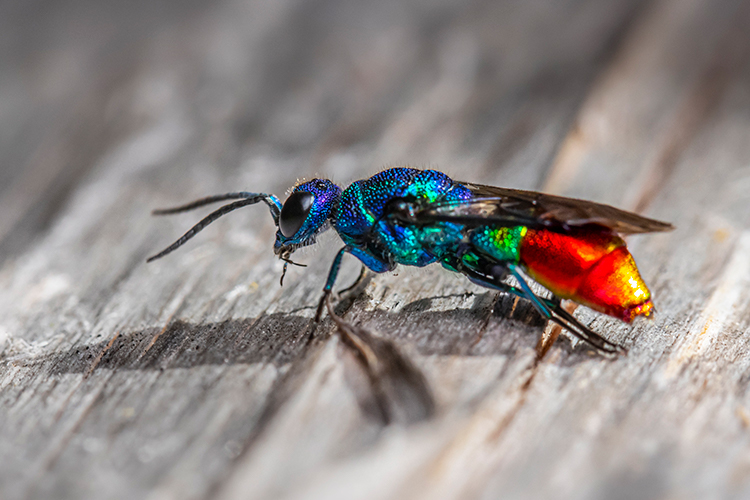
Imagine walking through a garden on a hot summer day when you suddenly notice an emerald sparkle fluttering among the flowers. But it is not a jewel — it is one of the most beautiful insects on our planet, the cuckoo wasp, often called the emerald wasp.
What Lies Behind The Metallic Sheen?
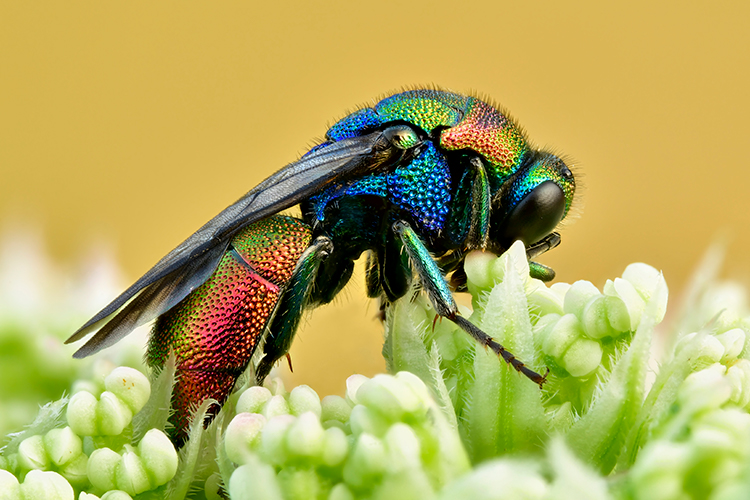
The cuckoo wasp belongs to the family Chrysididae — a vast group of parasitic wasps that includes more than 3,000 species worldwide. Until 2009, scientists did not know exactly how their stunning coloration was created. It turned out that this magical effect arises from the refraction of light through open spaces between six layers of cuticle in the wasp’s exoskeleton.
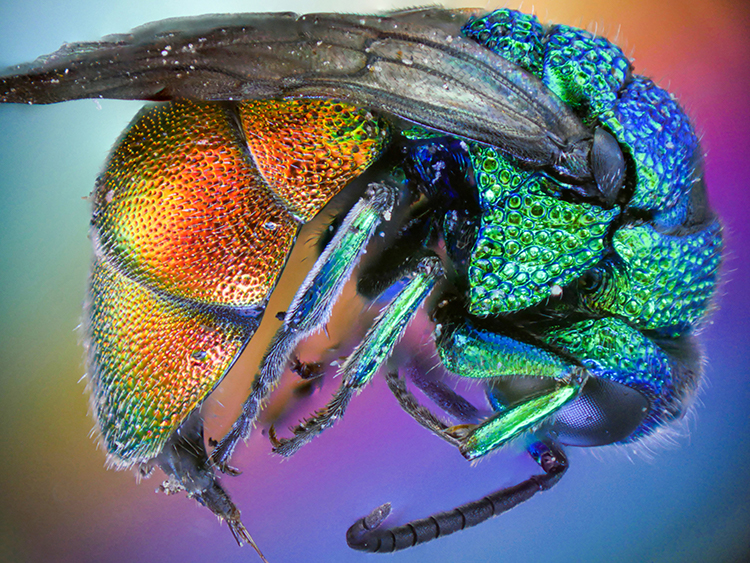
The surface of the body is deeply and densely pitted, giving it a shimmering, glossy appearance. This phenomenon is called structural coloration — the color is not created by pigments but arises due to the special surface structure, which reflects light waves in different ways.
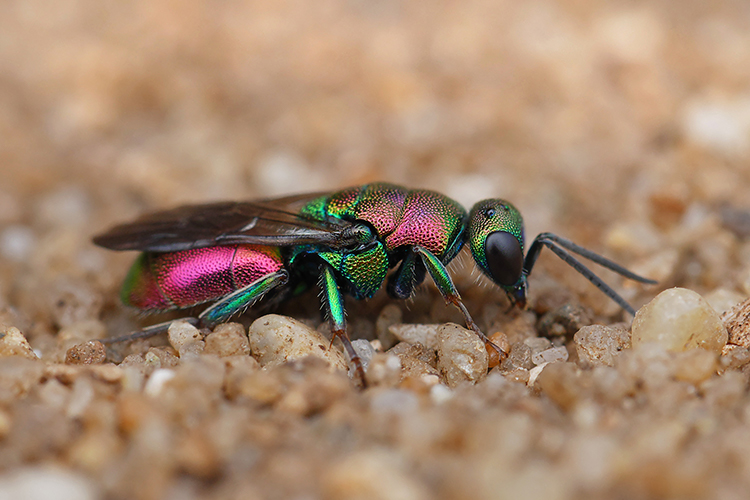
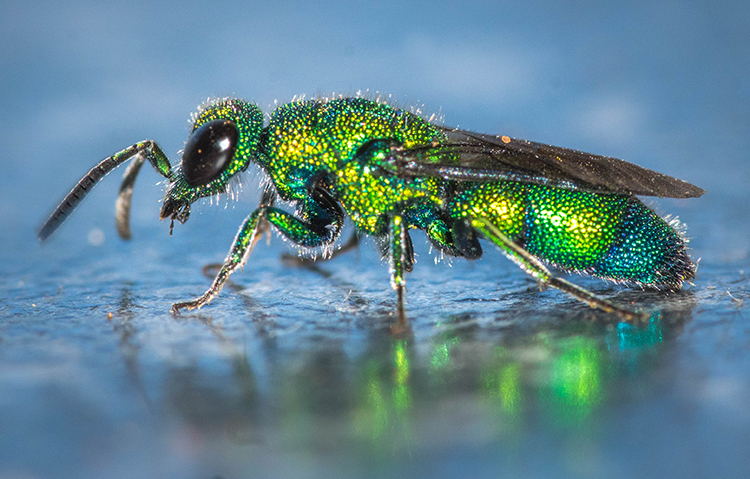
The coloration can change depending on the viewing angle, creating a fascinating play of light. Most species shimmer with emerald-green and blue tones, but there are also golden, purple, and even ruby-red representatives.
The Lifestyle Of A True Deceiver
The name “cuckoo wasp” did not appear by chance. Like cuckoo birds that lay their eggs in the nests of others, these wasps lay their eggs in the nests of other wasps and bees.
The female cuckoo wasp places her egg in the unfinished nest of another wasp or bee. Later, the host seals the nest, placing its own egg inside along with food for the future larva. But the devious plan is already set in motion: the cuckoo wasp larva either eats the other larva or dooms it to starve by consuming all the food.
There are two main parasitic strategies:
- Direct Attack: the larva immediately eats the host’s egg or young larva
- Resource Theft: the larva waits until the host grows, then kills it and takes all the food supplies
Masters Of Survival
Most cuckoo wasps are small, rarely exceeding 1.2 centimeters in length. But do not be fooled by their tiny size — these creatures are true survival experts.
Since their hosts have stingers and biting jaws, cuckoo wasps evolved special defense mechanisms: a thickened body covering and the ability to curl into a ball, tucking their legs inside. A flexible abdomen allows the insect to roll into a ball when threatened or attacked.
In most species, the thorax has special depressions for holding the legs, and the abdomen is flat or hollow underneath and covered above by three convex plates. This design turns the wasp into a living armored capsule.
Where To Find Living Jewels
Cuckoo wasps are most diverse in desert regions of the world, as they are usually associated with solitary bees and wasps, which are also most diverse in such areas. They fly mainly in the hottest and driest months of summer in subtropical and Mediterranean climates.
They prefer dry areas and sandy soils; many species are tied to a narrow type of microhabitat where adults can rest or find hosts for parasitism. Some species visit flowers of plants from the Apiaceae, Asteraceae, and Euphorbiaceae families.
Many discoveries are explained by people either noticing brightly colored wasps hovering near walls in search of host nests, or finding them after they entered buildings and became trapped on the inside of window glass.
The Role In The Ecosystem
Despite their parasitic lifestyle, cuckoo wasps play an important role in natural ecosystems. Adults feed on nectar and sometimes honeydew produced by aphids and are important pollinators. They help control populations of other insects, maintaining ecological balance.
Camouflage Or Decoration?
Recent studies revealed an apparently paradoxical explanation for structural coloration in insects — as a form of camouflage. Research showed that iridescent objects can be difficult to identify against similarly colored backgrounds such as green leaves, making the colored insect harder to spot.
Remarkably, bright iridescence may hinder recognition of shapes by some hymenopterans, explaining how the striking coloration of cuckoo wasps may conceal them from their hosts. Thus, their beauty is not just decoration but a sophisticated survival tool.
Species Diversity
In the genus Chrysis alone, more than 1,000 species have been described. California — a true paradise for cuckoo wasps — is home to 166 species, and there are about 230 species across North America. This diversity may be linked to the large number of native bee species that serve as hosts for these parasites.
What Makes Them Special?
Cuckoo wasps are unique among all insects. Their combination of striking beauty, complex social behavior, and amazing adaptations makes them some of the most fascinating creatures in the insect world. Their parasitic lifestyle has led to the evolution of remarkable adaptations, including chemical mimicry of host odors in some species.
Next time you see a metallic shimmering insect in the garden, stop and admire — you are looking at one of nature’s most perfect creations, a living work of art shaped by millions of years of evolution.
Cuckoo wasps remind us that nature is the greatest artist and engineer at the same time. In their tiny bodies, they combine the beauty of precious stones with the complexity of high-tech devices, created not by humans but by life itself.