Українська
  Русский
  Polski
  Deutsch
  Français
  Español
  Nederlands
  Svenska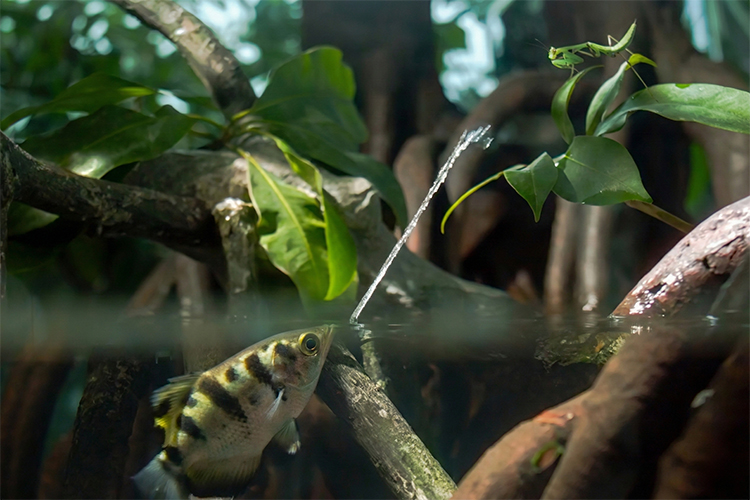
© Factum-Info
Imagine a hunter capable of hitting a target several meters away while staying in a completely different element and looking through the light-refracting surface of the water. Meet the archerfish (also known as the spinner fish) — one of the most amazing creatures on our planet.
In this article, we will look “under the hood” of this natural weapon to understand how the fish’s mouth turns into high-precision pneumatics, and find out how these masters of ballistics bypass the laws of physics, predicting the prey’s drop point in a split second.
Where Aquatic Marksmen Live
Archerfish inhabit warm waters from India and Sri Lanka to the Philippines, Australia, and Oceania. They can be found in fresh water bodies, mangrove forests, and estuaries where salt water mixes with river water.
To date, scientists know of 10 species of these fish. The largest representatives, such as the spotted archerfish, can reach 40 cm in length, although most species grow to 15–25 cm. Notably, these fish have maintained their unique body plan for millions of years, as confirmed by fossil findings of their ancestors.
Living Pneumatics: How the “Shot” Works
The main feature of the archerfish is its ability to knock insects off branches and leaves using a directed jet of water. This is not just a random spit, but a complex process requiring unique anatomical adaptations:
- Barrel anatomy: A deep longitudinal groove runs along the fish’s palate. When the archerfish presses its long and mobile tongue against it, this groove turns into a narrow tube acting as a gun barrel.
- Pressure source: The ejection mechanism is powered by a sharp contraction of the gill covers, creating excess pressure in the oral cavity.
- In-flight amplification: The fish actively manages the hydrodynamics of the jet. It releases the initial portion of water at a speed of about 2 m/s, and accelerates the subsequent portion to 4 m/s. As a result, the “tail” of the stream catches up with its “head,” forming a single massive water ball right before hitting the target.
- Power: This effect allows for a specific impact power of 3,000 W/kg, which is six times greater than the capabilities of any vertebrate muscle tissue. The fact is that many insects hold onto leaves very tightly — their grip strength can exceed their own weight by 10 times. To make the prey fall into the water, it must be knocked down by a powerful blow, not just wetted.
The shooting range can be up to 2 meters, and the ability to “shoot” appears even in juveniles just 2.5 cm long.
In the video player, you can enable subtitles and choose their translation to any language in the settings.
Intelligence and Visual Calculations
Archerfish possess cognitive abilities that, in some aspects, surpass those of many mammals.
The Mathematics of Refraction
Aiming from water into the air involves serious optical distortions. According to the laws of physics, the object appears to the fish to be higher and closer to the zenith than it actually is. Archerfish successfully compensate for this deviation, which can reach 25°, demonstrating amazing accuracy across a wide range of angles.
Predicting the Future
A successful hunt does not end with the shot. Within a split second after the prey is hit, the archerfish performs a sharp maneuver — the “C-start.” The fish turns not toward the insect’s current position, but toward the calculated point of its impact. The fish’s brain instantly calculates the trajectory based on the target’s initial speed and height.
Facial Recognition
In 2016, researchers proved that archerfish are capable of recognizing human faces. In experiments, the fish successfully identified a “familiar” face among 44 new variants with up to 86% accuracy. This discovery proved that to recognize complex images, a brain does not necessarily need a neocortex — that “advanced” part of the cortex responsible for higher thinking in mammals.
Social Life and Hunting Tactics
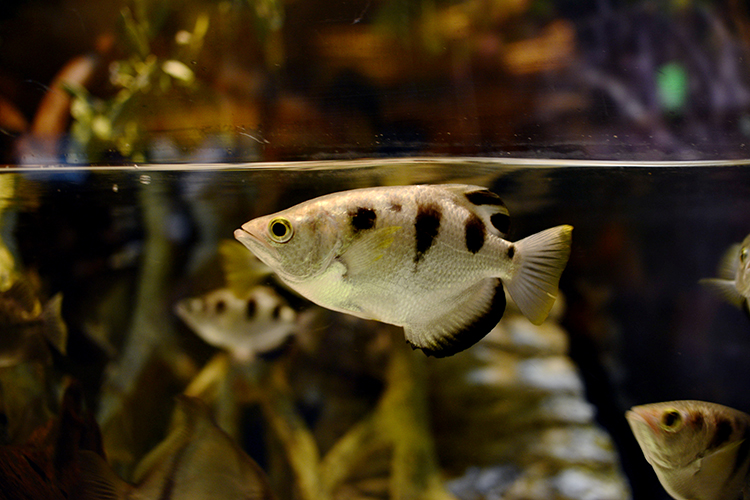
Archerfish are schooling fish, and competition within the group is very high. This forces them to choose between two main strategies:
- Water shooting: Effective at long distances (up to 2–3 meters) and has nearly 100% accuracy in adult individuals. However, the prey falls at a distance, increasing the risk of it being stolen by kin.
- Jumping from water: Fish can jump to a height of up to 2.5 times their body length. The jump ensures an instant capture of the prey, which is critical when competitors are present.
Interestingly, archerfish are also capable of social learning: young individuals learn accuracy by observing experienced relatives. Despite the competition, under certain conditions, they can show elements of pro-social behavior by choosing targets that benefit a tank neighbor as well.
A Universal Predator
Although shooting is their calling card, the archerfish diet is much more diverse than it might seem. Scientists’ observations of what these fish eat showed a strong dependence on age:
- Juveniles indeed obtain up to 61% of their food volume from terrestrial insects.
- Adults become dominant predators in river mouths — where fresh water meets salty sea water. They feed primarily on crabs, as well as small fish and even floating vegetation (mangrove seeds and fruits).
The Future of Nature’s Snipers
To date, most archerfish species are not under direct threat of extinction. However, they face local problems: the destruction of mangrove forests due to farm expansion and water pollution by pesticides, which reduce insect populations.
The preservation of these unique creatures depends directly on the protection of mangrove ecosystems, which serve as their home and a natural training ground for their amazing hunting.
School of Mastery: How Young Archerfish Adopt Hunting Techniques from Adults
In the video player, you can enable subtitles and choose their translation to any language in the settings.