Українська
  Русский
  Polski
  Deutsch
  Français
  Español
  Nederlands
  Svenska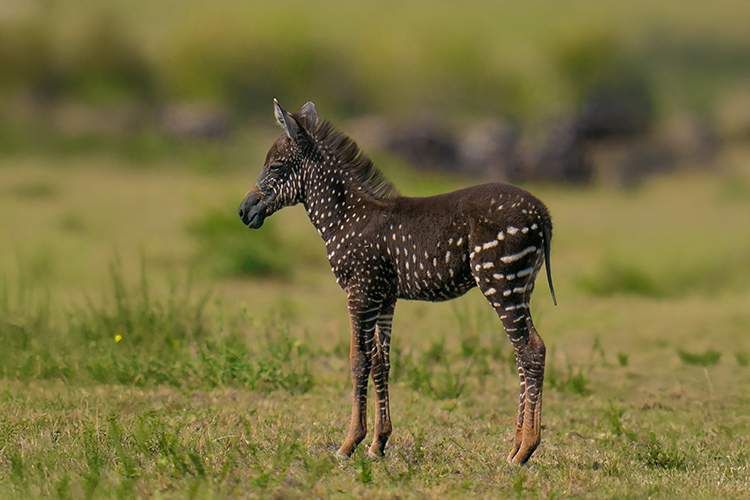
Picture a zebra. Your brain instantly draws black-and-white stripes. It is one of the most recognizable patterns in the animal kingdom, a symbol of the African savanna. But what happens when nature decides to break its own rules?
In September 2019, an event occurred in the Masai Mara National Reserve in Kenya that shocked biologists, photographers, and tourists from around the world. Among thousands of ordinary striped animals, a unique foal was discovered whose fur, instead of the usual lines, was covered with white dots and spots resembling polka dots.
The Discovery That Was Mistaken for a Prank
Early on the morning of September 13, 2019, guide Antony Tira noticed a strange animal in the herd. At first glance, the foal looked so unusual that the guide assumed someone had captured a zebra and painted it for a prank or a scientific experiment.
However, upon closer inspection, it became clear: this was neither paint nor a new species. It was a week-old zebra with an extremely rare genetic mutation. Photographer Frank Liu, who was looking for rhinos that day, took the first pictures of the animal, which instantly went viral. Following the national park’s tradition, the foal was named Tira—after the guide who first discovered him.
Why Is Tira Polka-Dotted? The Scientific Explanation
To understand how Tira came to be, we need to understand how zebras get their color. All zebras have black skin. Special cells called melanocytes produce melanin, the pigment responsible for the black color. White stripes appear where a genetic program “turns off” pigment production during the embryonic stage.
Tira’s case is pseudomelanism (or abundism). This is a rare genetic mutation where the stripe formation process malfunctions. Dark pigment continues to be produced where it shouldn’t be, and instead of distinct white stripes, only sparse white spots or dashes remain on a dark background.
The Price of Uniqueness: Why Stripes Are Vital for Survival
To humans, Tira is a wonder of nature, but for the zebra itself, such coloration is a serious challenge. Scientists have argued for decades about why zebras have stripes, proposing theories ranging from camouflage to thermoregulation. However, today science leans toward one main answer: protection against insects.
How stripes work:
- Dangerous flies (horseflies and tsetse flies) use vision to land on their victims.
- High-contrast stripes create an optical illusion that disrupts insect navigation. The flies simply cannot calculate the landing and crash into the animal or fly past it.
- Experiments have shown that flies land on striped surfaces much less frequently than on solid-colored ones.
Deprived of this natural protection, Tira is more vulnerable to bites, and consequently, to deadly diseases carried by flies (such as equine influenza). Furthermore, it is much easier for a predator, like a lion, to single out and pursue an individual in a herd that visually stands out from the rest.
Tira’s Fate: A Chronicle of Survival
When photos of Tira went around the world, many experts were pessimistic. In the wild, animals with such abnormalities rarely live long. In a similar case in Botswana, not a single spotted foal survived to six months.
However, Tira surprised everyone:
- 2019: After discovery, Tira migrated with his mother and the herd to Tanzania (Serengeti Park).
- 2020: There was no news about the zebra. Many assumed he had died.
- 2021: Tira returned! He was spotted in Kenya, now older, at the age of about two years. He successfully covered hundreds of kilometers of migration and survived where others perished.
The fact that Tira lived to two years proves that the herd did not reject him. Studies from South Africa confirm: zebras do not discriminate against kin based on color and can interact normally and even mate with “non-standard” individuals.
Unfortunately, there have been no confirmed sightings of Tira since 2021. Given the high mortality rate among wild zebras and the specific risks for Tira, the likelihood that he is alive today is low. But the two years he spent in the savanna were a true triumph of life against the odds.
Tira’s story is a reminder of nature’s infinite variety. Even errors in the genetic code can create beauty that helps scientists better understand evolution and the laws of survival in the wild.
Amazing Facts: Things You Didn’t Know About Zebras
- The Deadly Kick. Zebras look like cute horses, but in a fight for life, they turn into fierce warriors. A kick from a zebra’s rear hooves possesses monstrous force—it can break a lion’s jaw. For a predator, such an injury means an inability to hunt and a slow death from starvation. That is why lions often think twice before attacking a healthy adult stallion.
- Black or White? An old childhood question has a precise scientific answer: zebras are black. Embryologists have found that the embryo’s skin is initially dark, and white stripes appear later due to the “deactivation” of pigmentation in certain areas. If you shave a zebra, it will be coal-black.
- Nature’s Barcode. Every zebra’s stripes are as unique as human fingerprints. Scientists use special computer programs to scan the patterns on the animals’ flanks and identify specific individuals for observation without resorting to microchipping.
- Migration Geniuses. Zebras have a phenomenal memory for routes. There was a case in Botswana where zebra herds immediately resumed an ancient migration path (over 500 km) after humans removed fences that had blocked the road for 50 years. Knowledge of the route was passed down from generation to generation, even when the path itself was closed.
-
Zorses and Zonkeys. Zebras can crossbreed with other equids, although this happens extremely rarely in the wild.
- Zorse: A hybrid of a zebra and a horse.
- Zonkey: A hybrid of a zebra and a donkey (they look like donkeys in striped “stockings”). Such hybrids are usually sterile and cannot have offspring.